ADHD and Voice Dictation: How Speaking Keeps You in Flow
For people with ADHD, typing constantly interrupts the thought that's trying to get out. Here's why speaking is often a better match for how ADHD minds actually work.
SERP Transcribe Team
Product
ADHD affects executive function — the set of cognitive processes that handle planning, working memory, and managing the gap between intention and action. One of the less-discussed ways this shows up is in writing: the process of translating thought into typed text is often particularly difficult for people with ADHD, for reasons that go beyond just distraction.
Voice dictation doesn't cure executive function difficulties, but for many ADHD users it removes specific friction points that make writing disproportionately hard.
Why Typing Is Hard for ADHD Brains
Working memory overload. Typing requires holding a thought in working memory while simultaneously performing the motor task of typing it. For neurotypical people, this is automatic enough not to be disruptive. For many ADHD brains, working memory is a limited and unreliable resource — by the time the thought has been transcribed, part of it is gone.
The interruption cost is higher. Everyone loses their train of thought when they make a typo and stop to correct it. For ADHD users, the cost of that interruption is often higher — the thought that was interrupted may not return, and the detour into correction mode can lead somewhere else entirely.
The blank page problem amplifies. Many people experience difficulty getting started on writing tasks. For ADHD brains, the activation energy required to begin a writing task — to put the first word on the blank page — can be extremely high, sometimes paralyzing. The cursor blinks. Nothing happens. This isn't laziness; it's executive function difficulty around initiation.
Hyperfocus cuts both ways. ADHD minds can hyperfocus, but the focus often goes to the wrong thing. In typing, the focus might go to perfectionism — agonizing over word choices, deleting and rewriting the same sentence — rather than getting thoughts out.
Why Voice Works Better for Many ADHD Users
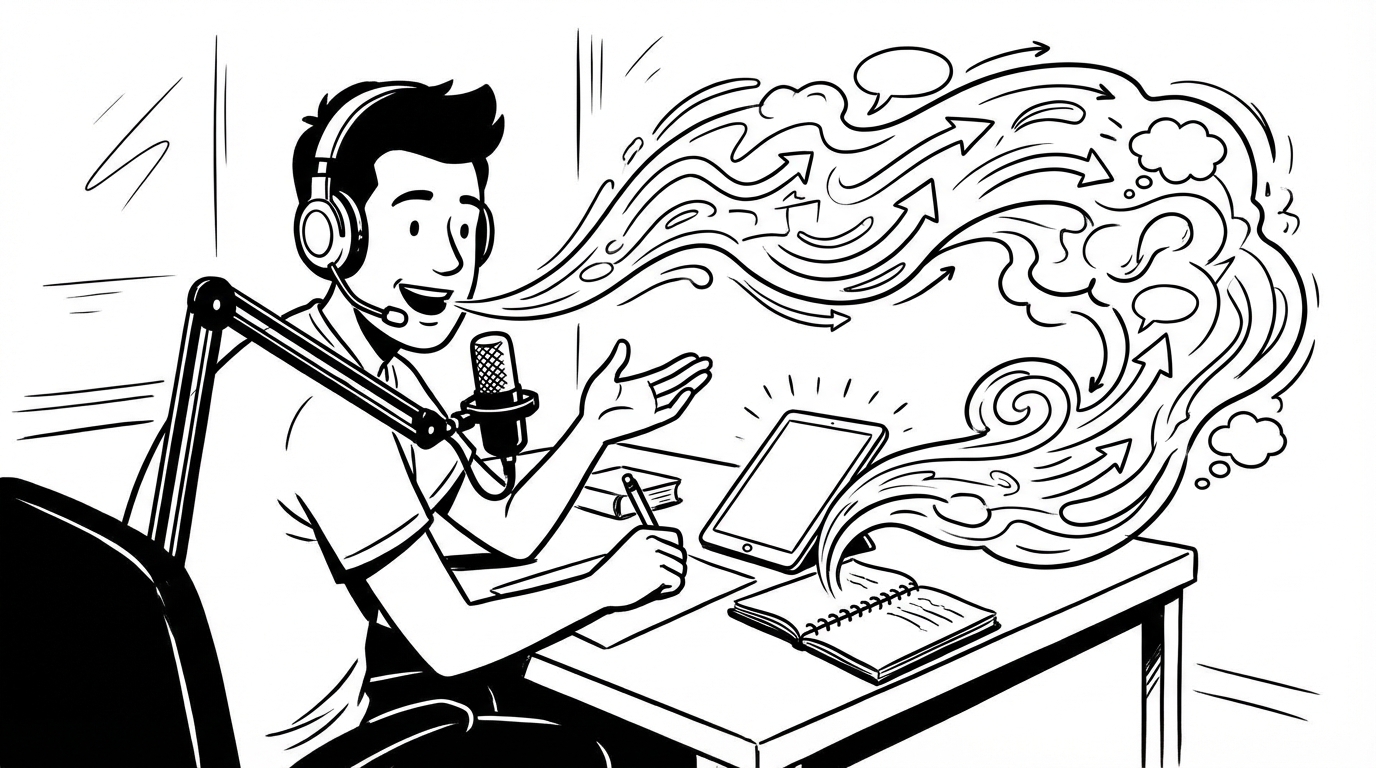
Speaking keeps pace with thought. The speed of speech is closer to the speed of thought than the speed of typing. When you speak, you don't have time to second-guess each word before you've said it — you commit to the thought in real time. This is often helpful for ADHD brains that struggle with perfectionism and overthinking.
Lower working memory demand. Speaking doesn't require dividing cognitive resources between holding a thought and performing a motor task. You think it, you say it, it's captured. The working memory freed up by not needing to type can stay focused on the content.
Easier initiation. Holding a button and speaking is lower activation energy than sitting at a keyboard and producing a first sentence. The physical act of holding the hotkey is a cue that helps some ADHD users initiate. The output is immediate — you hear yourself start, and starting often generates momentum.
Interruptions are less derailing. With push-to-talk dictation, a "typo" (mis-spoken word) doesn't interrupt the flow — you just keep speaking and fix it in the editing pass. The interruption structure is fundamentally different. You're not stopping to correct mid-stream; you're producing first and editing second.
Practical ADHD-Friendly Workflows
Brain dump first, structure later. Hold the hotkey and speak everything on your mind about the topic — no structure, no order. Just get the thoughts out. Then organize the text. For ADHD brains that struggle to plan and write simultaneously, separating these into two distinct phases can unlock writing that never happens when both are required at once.
Time-boxed dictation bursts. Hold the hotkey for 60–90 seconds maximum, review what you got, then take a five-second break before the next burst. This rhythm can help ADHD users who struggle with sustained attention — short bursts with natural breaks, rather than attempting continuous sustained composition.
Voice reminders and capture. ADHD minds generate thoughts constantly and lose them just as quickly. The two-second capture habit — hold hotkey, speak the thought, paste into your notes — is a particularly good match for the ADHD experience of "had an idea, lost it before I could write it down."
Speak to the blank page. If you're stuck on a blank document, hold the hotkey and literally speak to it: "Okay I need to write an email to David about the project delay and I don't know how to start. I guess what I want to say is that we're going to miss the deadline and it's partly because of the spec changes in week three..."
You just started the email. Keep going.
This Isn't a Cure
Executive function difficulties are complex. Voice dictation helps with specific aspects of the writing problem — the transcription overhead, the working memory load, the blank page initiation difficulty. It doesn't help with every aspect of ADHD that affects writing, and it won't work equally well for every person.
But for ADHD users who've found typing consistently gets in the way of getting thoughts out, it's worth a genuine try. Not a one-day test — at least two weeks of regular use, so the mechanics become automatic and you can assess whether the underlying flow experience actually improves.
Many ADHD users who switch to voice dictation report that it's one of the more meaningful productivity changes they've made — not because it solved everything, but because it removed the specific bottleneck that was blocking them the most.
Your thoughts move fast. Speaking might be the best way to keep up.