Beat Writer's Block With the Speak First, Edit Later Method
Why speaking your first draft out loud is one of the most effective ways to break through writer's block — and how SERP Transcribe makes it a practical daily habit.
SERP Transcribe Team
Product
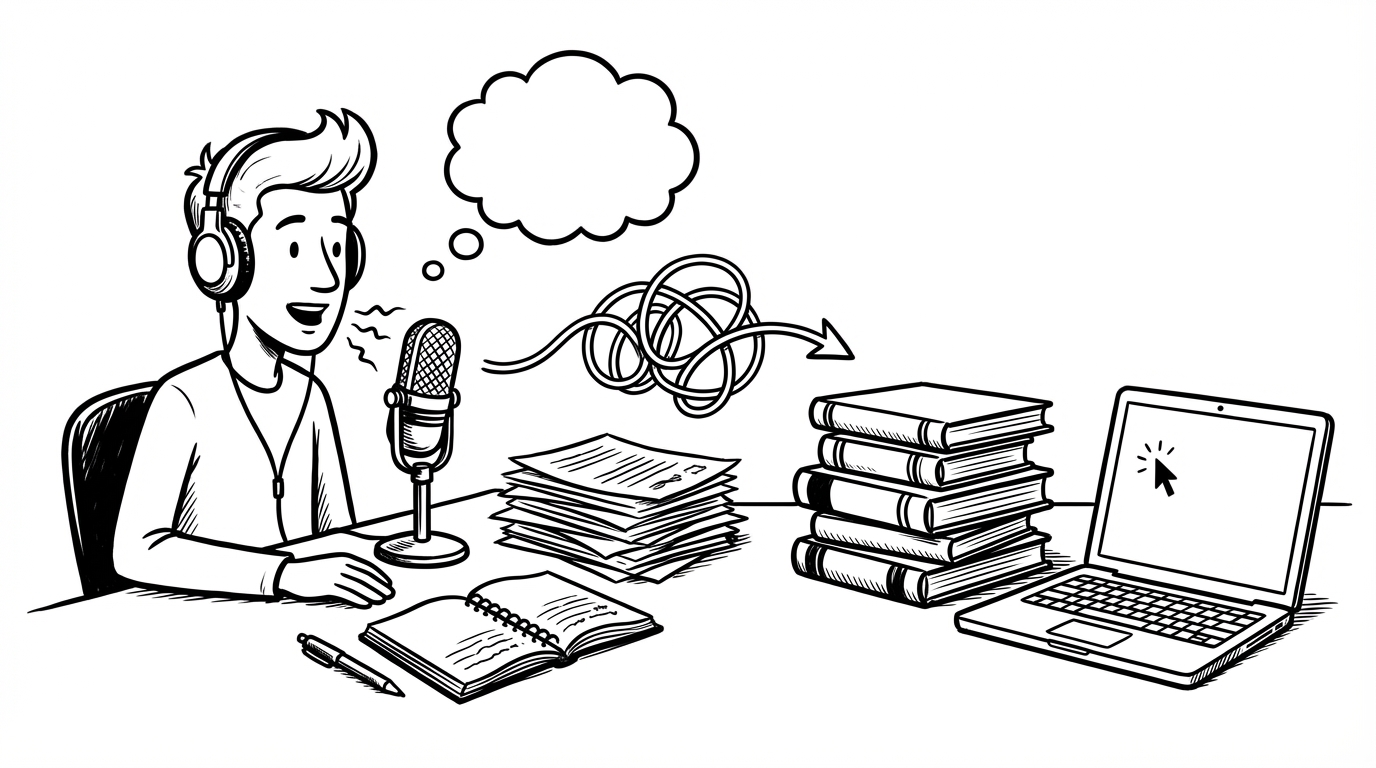
Writer's block isn't usually about not having ideas. It's about the gap between having an idea and having a perfect sentence on the page. The pressure to produce polished text on the first pass is what stops most people cold.
Speaking bypasses that pressure almost entirely.
Why Speaking Feels Different Than Typing
When you type, you're composing and editing simultaneously. Every word you put down feels like a commitment. You second-guess sentences, delete lines, stare at the cursor. The act of typing has editing baked into it.
When you speak, something different happens. You're not looking at text being formed — you're just talking. The part of your brain that monitors and critiques written output isn't as active. Words come out more freely because the feedback loop is different.
Writers have exploited this for decades with dictation (author Barbara Cartland reportedly dictated her entire body of work; more recently, many thriller writers use dictation to maintain volume output). The principle is the same regardless of what you're writing: speaking a draft is often faster and less blocked than typing it.
The Speak First, Edit Later Workflow
The method is simple:
- Don't open a blank document and try to write. Instead, hold your SERP Transcribe hotkey and speak.
- Say whatever you're thinking — even roughly. You're not writing. You're just talking about the thing you want to write.
- Release the hotkey, paste the text. Don't read it yet.
- Keep going. More bursts. More talking. Get it all out.
- Only after you've spoken the whole thing — or a substantial chunk — do you read it.
By the time you read back what you've said, you have raw material to work with. A blank page is gone. The editing mind has something to improve rather than something to create from nothing.
This is the "speak first, edit later" method, and it works because it separates two cognitively different tasks: generation (speaking) and refinement (editing). Trying to do both at once is why the blank page is hard.
What to Speak When You Don't Know What to Say
The most common objection: "But what if I don't know what I want to say yet?"
Speak the confusion. Literally.
"Okay so I need to write this section about the pricing model and I'm not sure how to approach it. I think I want to start by explaining why the free tier matters, and then move into why someone would upgrade. But I'm not sure if I should address the price objection upfront or later. Let me just try to explain the value first..."
That's not perfect writing. It's thinking out loud. But now you have raw material — a framework, some questions answered, some direction identified. Edit it, tighten it, and you have a section.
Speak the uncertainty and the writing almost always follows.
For Different Types of Writing
Email: If you're stuck on a difficult email — delivering bad news, asking for something awkward, navigating a conflict — speak it conversationally first. "Here's what I need to say: I'm not going to make the deadline, and here's why, and here's what I'm going to do about it." That casual version is often 80% of the way to a good email. Clean it up and you're done.
Reports and documents: Start with a verbal outline. "This report needs to cover three things: the results from Q1, why we missed the target, and what we're changing. Let me start with the results..." Now you have a structure and a first pass at the opening. Much easier to continue than staring at a title.
Creative writing: The "speak whatever comes" technique is especially powerful for fiction or creative nonfiction. Describe a scene out loud. Narrate what happens next. Don't worry about prose quality in the spoken draft — that's what editing is for.
The Permission to Be Rough
The real power of this method is the permission it gives you to be rough on the first pass. Because you're speaking, not writing, the output is automatically understood to be a draft. You're not committing to anything. You're generating.
That permission is the thing that breaks the block.
Once you have rough material to work with, the editing is enjoyable. You're shaping something that exists rather than creating something from nothing. The hard part — getting past the blank page — is already done.
SERP Transcribe is a particularly good fit for this method because the burst-and-paste workflow maps naturally to "speak a chunk, see what you have, keep going." You're never locked into a long session or a mode — you're just grabbing the hotkey when you're ready to generate, and releasing when you want to see what came out.
Speak first. Edit later. The blank page doesn't stand a chance.