How Consultants Use Voice Notes for Client Deliverables
How management consultants, freelance consultants, and independent advisors use voice dictation to draft deliverables, capture meeting insights, and communicate with clients faster.
SERP Transcribe Team
Product
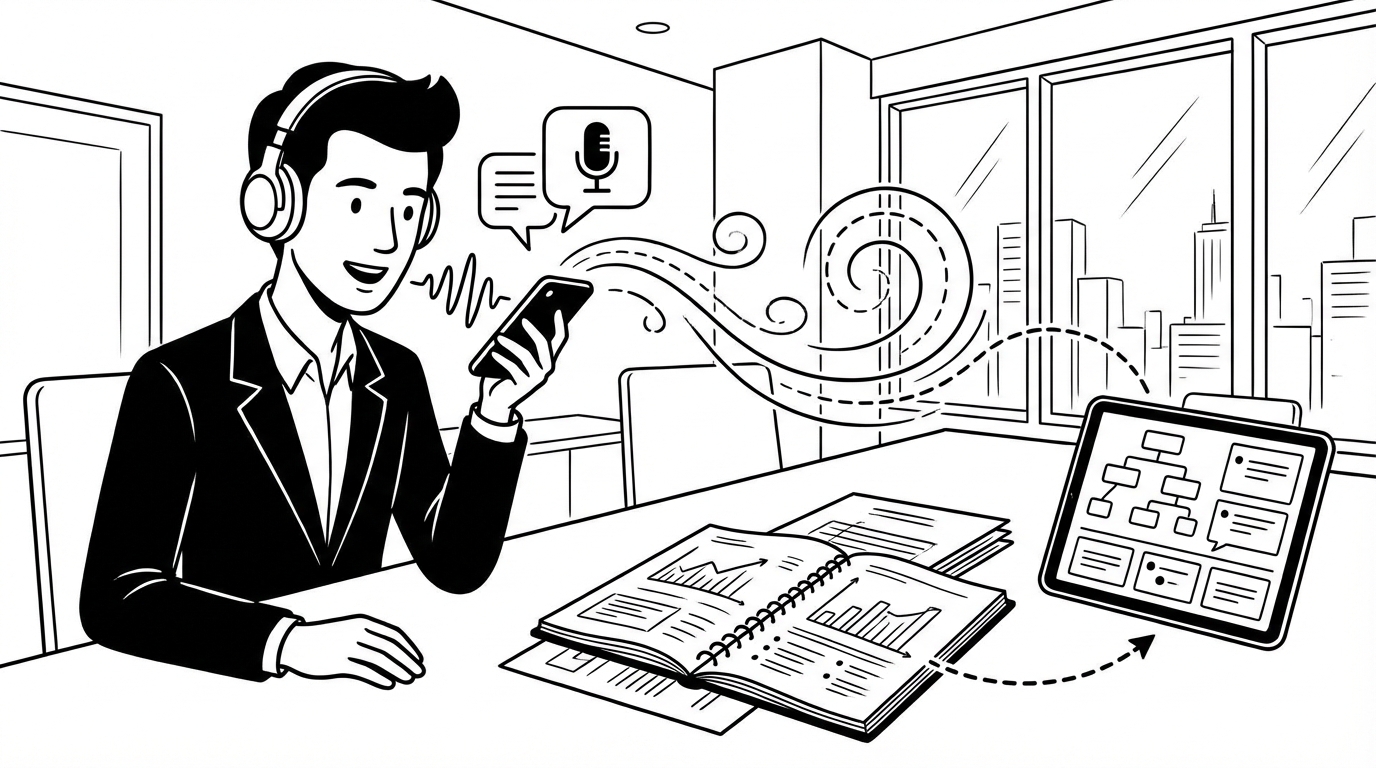
Consulting is fundamentally a knowledge transfer business. You understand something your client doesn't, and you get paid to transfer that understanding in a useful form — reports, recommendations, frameworks, analysis. The bottleneck is almost always the translation from your understanding to a written deliverable.
Voice dictation cuts that translation time significantly. Here's how experienced consultants use it across their work.
The Deliverable Drafting Problem
Consultants often know what they want to say before they start writing. The interviews are done. The analysis is complete. The recommendation is clear. But sitting down to translate that into a 20-page report or a 10-slide deck narrative still takes hours.
The reason: typed composition and clear thinking don't happen at the same speed. Your brain works faster than your fingers. You find yourself stopping to choose words, restructure sentences, second-guess phrasing — all of which slows the translation and fragments the thinking.
Speaking doesn't have this problem. When you know what you want to say, you say it. The ideas flow at speaking speed, which is faster than typing speed, and the output captures your thinking before the internal critic has time to interrupt.
Dictating the Executive Summary
The executive summary is the most read section of any consulting deliverable and the hardest to write well. It needs to convey the situation, the recommendation, and the key rationale in a page or less — clear enough that a time-pressed executive can act on it without reading further.
Dictate it by speaking it as if you're explaining your findings to the client in the first five minutes of the readout:
"Here's where we landed. You have a customer acquisition cost problem, not a conversion problem. Traffic is fine, the website converts at industry standard, but you're spending three times the industry benchmark to get people there. The fix isn't in the funnel — it's in your channel mix. You're over-indexed on paid search, which is expensive and competitive in your category, and under-indexed on content and community channels where your target customers actually spend time. Our recommendation is to reallocate 40% of the paid search budget to content over the next two quarters and build the measurement infrastructure to attribute results properly. We think you can achieve the same customer volume at 30–35% lower CAC within 12 months."
That's a complete executive summary argument, spoken in about 45 seconds. It's direct, specific, and gives the client exactly what they need. Typed from scratch, the same clarity might take 30–45 minutes to construct — because typing invites editing, and editing invites hedging, and hedging produces the kind of consultant-speak that executives hate.
Capturing Workshop and Interview Insights
Consultants run workshops and conduct stakeholder interviews as primary research. The synthesis of those sessions — identifying themes, capturing key quotes, noting disagreements or tensions — is typically done by typing notes after the session.
Dictation changes the timing: instead of writing synthesis notes at the end of the day when your recollection is incomplete, you dictate brief notes between sessions or immediately after, while the specific details are live in your memory.
Between interview sessions, dictate a quick synthesis:
"Interview three, CFO. Main themes: she's much more skeptical of the growth projections than the CEO — she doesn't think the sales team can execute at the required pace given current capacity. Key quote to capture: she said 'we keep projecting we'll hire our way out of the problem but the onboarding takes six months and then people leave.' She flagged the churn in the SMB segment as a potential leading indicator that nobody's paying attention to. Definitely need to triangulate this with the sales data."
Paste that into your interview log immediately. That 30-second dictation captures details — the specific quote, the pointed observation about leading indicators — that would evaporate by the time you're synthesizing at the end of the week.
Status Update Emails and Client Communication
Client status emails are a daily or weekly writing task for most consultants. They follow predictable formats: what happened this week, where we stand against the project timeline, what's coming next, any decisions needed from the client.
Dictating these is straightforward and fast. Speak through each section, paste, do a quick cleanup pass, send. A status email that would take 20 minutes to compose carefully takes 5 minutes with dictation.
More importantly, dictated status emails tend to sound more direct and human than typed ones. The over-formalized, hedged language that creeps into consulting communication — "it has been determined that," "per our prior conversation," "please find attached herewith" — doesn't come out naturally when you speak. The email sounds like a person updating another person. Clients respond better to that.
Slide Deck Narrative and Speaker Notes
For slide decks, dictation is useful specifically for the written narrative portions: the deck introduction, section transitions, and speaker notes.
Dictate the deck introduction: The framing page that tells the client what they're about to see and why it matters. This is pure narrative and benefits from the clarity that dictation produces.
Dictate speaker notes: For each slide, hold the hotkey and speak the 2–3 key points you'd make verbally when presenting it. These become the speaker notes that guide the presentation and serve as a record of the intended narrative.
Type the slide titles, bullets, and data labels: These need precision. Keep these keyboard-first.
The Thinking-While-Speaking Benefit
One unexpected benefit consultants report from dictation: the act of speaking out loud is a quality check on your reasoning. Arguments that seem solid in your head often reveal gaps when you have to speak them aloud. If you can't say it clearly, you don't understand it clearly — or the logic has a hole.
Dictating your analysis serves as a live thinking audit. You'll catch the places where your recommendation doesn't fully follow from your findings, or where a key assumption is doing more work than you've acknowledged. Better to catch it in the dictation phase than have a client catch it in the readout.
For Independent Consultants: The Time-to-Billable Advantage
Independent consultants and freelance advisors have an additional incentive: every hour spent writing is an hour not billed or not spent on business development. Cutting deliverable drafting time by 40–50% with dictation has a direct impact on margins and capacity.
An independent consultant who delivers one major report per month that takes 15 hours to write might bring that down to 9 hours with dictation. At a $200/hour billing rate, that's $1,200 in recovered capacity per month — either freed for additional client work or reclaimed as time.
The tool pays for itself in a single deliverable.