How Developers Use Voice Dictation During Code Reviews
Speed up your code review comments with voice dictation — write better feedback faster without breaking your review flow.
SERP Transcribe Team
Product
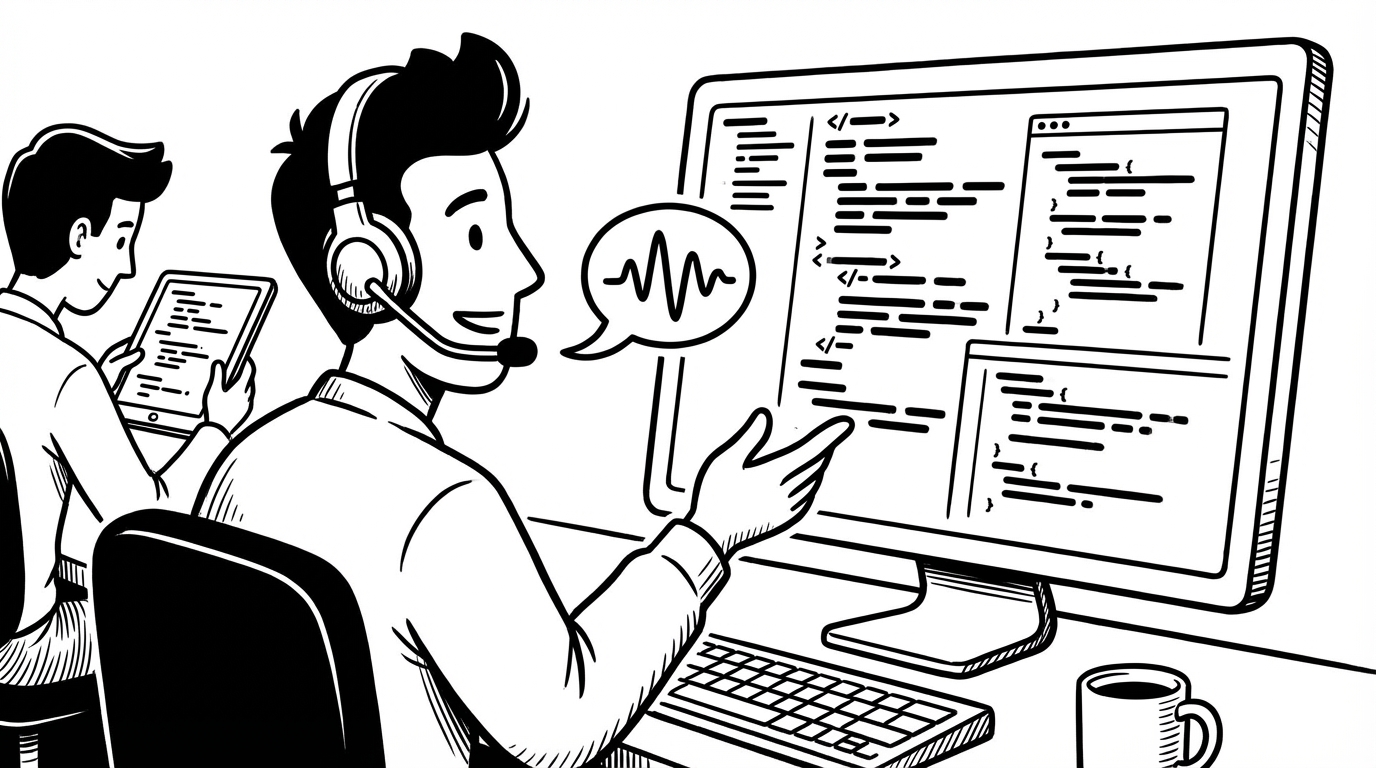
Code reviews are communication-heavy work. For every line of code you read, you might have a question, a suggestion, a concern, or a note to the author. Most of those thoughts stay unwritten because typing them out takes too long relative to what they contribute.
Voice dictation changes that ratio significantly. Here's how to use SERP Transcribe to leave better, more complete review feedback without slowing down your review pace.
The Code Review Comment Problem
Good code review comments are specific, constructive, and include enough context for the author to understand both what to change and why. Most code review comments are "nit:", "LGTM", or a single sentence that makes sense to the reviewer but leaves the author guessing.
The gap between what a reviewer thinks and what they write isn't knowledge — it's friction. Writing a thorough comment takes time, and when you're reviewing a 40-file PR at the end of the day, you're making constant trade-offs about how much to write.
Dictation cuts the write time by roughly 60–70% for prose comments. That changes the trade-off.
The Workflow for Inline Comments
GitHub, GitLab, Bitbucket — all accept paste input in comment boxes:
- Read the code, form your thought
- Click into the comment box on that line
- Hold hotkey, speak your comment, release
- Paste, do a quick scan, submit
Example of a dictated inline comment:
"This works for the happy path, but there's a missing nil check before the map access on line 47. If
useris nil here — which can happen if the session has expired — this will panic in production. Worth adding a guard clause at the top of this function that returns an early error if user is nil."
That comment — specific, explains the risk, suggests the fix — took about 20 seconds to speak. Most developers would write "nil check?" or nothing at all, because typing the full explanation feels disproportionate to the moment.
Types of Review Comments That Benefit Most
Architectural concerns: These require the most explanation and are most often left vague. "This approach might cause issues at scale" is unhelpful. Dictate the actual concern: why it's a problem, at what scale, what an alternative might look like.
Security observations: Same issue. "Could be a security concern" helps nobody. Speak the specific vector, the condition that triggers it, and the recommended mitigation.
Performance notes: "This could be slow" vs. a specific explanation of the O(n²) behavior and a suggestion for the better data structure.
Educational comments: When a senior developer wants to explain a better pattern to a junior developer, typing a full explanation often doesn't happen. Dictating it does — and those comments compound enormously in team knowledge transfer over time.
"I don't understand this" comments: These are actually some of the most valuable review comments, and they require context. "What's the purpose of this field?" can be spoken in 3 seconds. But "I'm not sure I understand the relationship between this field and the one in UserSession — could you add a comment explaining when this gets set and how it interacts with the auth flow?" is much more useful and takes 10 seconds to speak.
Dictating Summary Review Comments
Beyond inline comments, most code review tools have a summary comment where the reviewer gives an overall assessment. This is almost always the most under-written part of a review.
A good summary comment should cover: overall impression, the main concerns (if any), what the reviewer focused on, and any context the author should know for the next iteration.
Speak it at the end of the review when it's all fresh:
"Overall this is a solid implementation of the feature. Main concern is the missing error handling in the webhook processor — if the external API returns an unexpected response format, we'll silently drop events. The database query optimization on the batch processor looks good, that was the right call. One minor thing: a few of the new functions are missing docstrings. Approving pending the error handling fix."
That took 25 seconds. That summary would rarely get written otherwise.
Async Reviews and Remote Teams
For distributed teams doing async code reviews, comment quality matters even more — there's no opportunity to clarify verbally in a standup or a hallway conversation. The comment has to be self-contained.
Dictation makes it practical to write the self-contained comment the first time, rather than leaving a terse note that generates three rounds of async back-and-forth before the intent is clear.
A Note on Tone
One unexpected benefit of dictated review comments: they tend to be more conversational in tone. Written feedback can read as harsh in ways the writer didn't intend. Dictated feedback reads more like how you'd actually talk to the developer — which lands better and produces less defensive back-and-forth.
If you've ever had a review comment land worse than intended, experimenting with dictation is worth it for the tone shift alone.
Getting the Most Out of Review Dictation
A few practical habits that help:
Keep comments focused. One issue per comment, dictated as a complete explanation. Multiple concerns jumbled into one comment are harder to act on.
Speak the "why" first. Lead with the concern, then the specifics. "There's a race condition here — if two requests come in within the same millisecond..." is clearer than "what happens with concurrent requests?"
End with a clear ask. Finish each comment with what you want the author to do: "Add a guard clause," "Update the docstring," "Could you add a test for the null case?" Clear asks get actioned. Vague observations get ignored.
Review quality improves immediately. The author gets more useful feedback. You spend the same amount of time but produce significantly more value. That's the dictation win for code review.