How Students Can Use Voice Dictation for Notes, Essays, and Studying
Voice dictation isn't just for professionals. Students who use it for lecture notes, essay drafts, and study flashcards get more done with less friction.
SERP Transcribe Team
Product
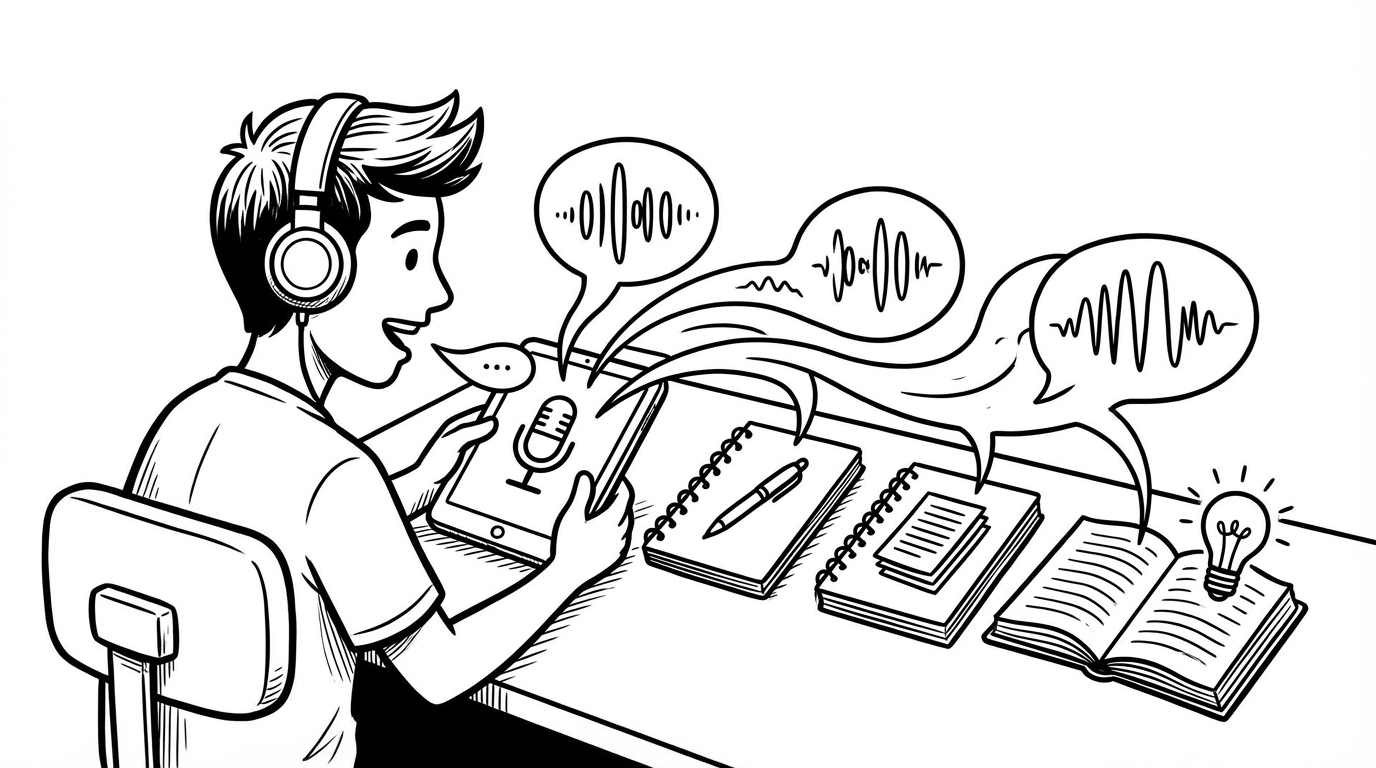
Typing speed is a surprisingly significant bottleneck in student life. Lectures move faster than most people can type. Essay drafts stall at blank pages. Study notes take so long to write that you don't actually review them. Voice dictation addresses all three.
Here's how students use SERP Transcribe to actually keep up — with lectures, with deadlines, and with the endless backlog of things that need to be written.
Lecture Notes
The classic lecture note problem: the professor is talking at 130 words per minute, you can type at 70, and you're constantly deciding which things are worth writing and which to let go. By the time you've written one point, two more have passed.
Voice dictation at lecture speed is much closer to keeping up. Speak in short bursts as the professor makes key points — you're not transcribing everything, you're capturing the most important sentences. Each burst is 5–10 seconds, and you end up with much more complete notes than typing allows.
Practical setup for lectures:
- Sit where you can speak quietly without disturbing others (end of a row, near the back)
- Use a low-profile earphone mic if needed
- Dictate key points as they come — "the main argument here is X," "formula for Y is Z," "this will be on the exam"
- Don't try to get everything, just the things worth keeping
After lecture, do a 10-minute cleanup pass while it's still fresh — fill gaps, fix any transcription errors, organize into a structure.
Essay First Drafts
The blank document is the enemy of every essay. The cursor blinks. The word count stays at zero. You know vaguely what you want to argue but the sentence won't come.
Speaking your essay draft is a way to completely bypass the blank page problem. You're not writing — you're thinking out loud, and the text appears as a byproduct.
The speak-first method for essays:
- Open a scratch document
- Hold your hotkey and explain your essay to an imaginary person: "Okay so my argument in this essay is that X. The reason I think this is because of A, B, and C. I'm going to start with A because it's the most obvious, and then build to C which is the most interesting part..."
- Keep going. Don't stop to edit.
- When you've spoken through everything you know, stop
- Now read back what you have — it's rough, but it's a first draft
The spoken version will be conversational and loose. That's fine. Editing a loose first draft into a proper essay is much faster and less painful than producing a polished first paragraph from nothing.
Study Flashcards and Active Recall
Writing flashcards or study notes by hand is slow enough that many students skip it. Dictation makes creating study materials fast enough to actually do.
Creating flashcards by voice: Open your flashcard app (Anki, Quizlet, Notion) and for each concept, dictate: "Front: what is the difference between mitosis and meiosis. Back: mitosis produces two identical daughter cells for growth and repair, meiosis produces four genetically varied cells for sexual reproduction."
Speak the question and answer together, paste, split them into the front/back fields. You can create twenty cards in the time it usually takes to write five.
The bigger win — talking out loud to study: Active recall (testing yourself by trying to explain something without looking) is one of the most effective study methods. Dictating your knowledge into a doc is a form of active recall with a byproduct — you end up with revision notes. Speak what you know about a topic without looking at your materials, then check what you missed.
Emails to Professors and Admin
The email a student owes a professor — requesting an extension, asking a question about the assignment, following up on feedback — tends to sit unsent for days because writing to a professor feels formal and the tone is hard to calibrate.
Speaking it is easier than typing it because you naturally find a respectful but genuine tone. "Hi Professor Williams, I wanted to ask about the essay due on Friday — I've been dealing with a family situation this week and I'm wondering if there's any flexibility on the deadline. I've already done most of the research, I just need another day or two to write it up properly."
Speak it, paste it, send it the same day instead of next week.
The Exhausted Student Problem
Late in a semester, when every assignment is due at once and you're running on low sleep, the activation energy required to open a document and start writing can feel enormous. The friction of typing compounds with the cognitive depletion of crunch time.
Voice dictation has a lower activation energy than typing — you just hold a button and talk. For exhausted students, that difference is sometimes the difference between submitting something and submitting nothing.
It won't write the essay for you. But it'll get words on the page when typing won't.