PhD Students: Write Your Dissertation Faster With Voice Dictation
Dissertation writing involves sustained, high-volume prose production under time pressure. Voice dictation changes the pace of chapters, literature reviews, and the daily writing habit.
SERP Transcribe Team
Product
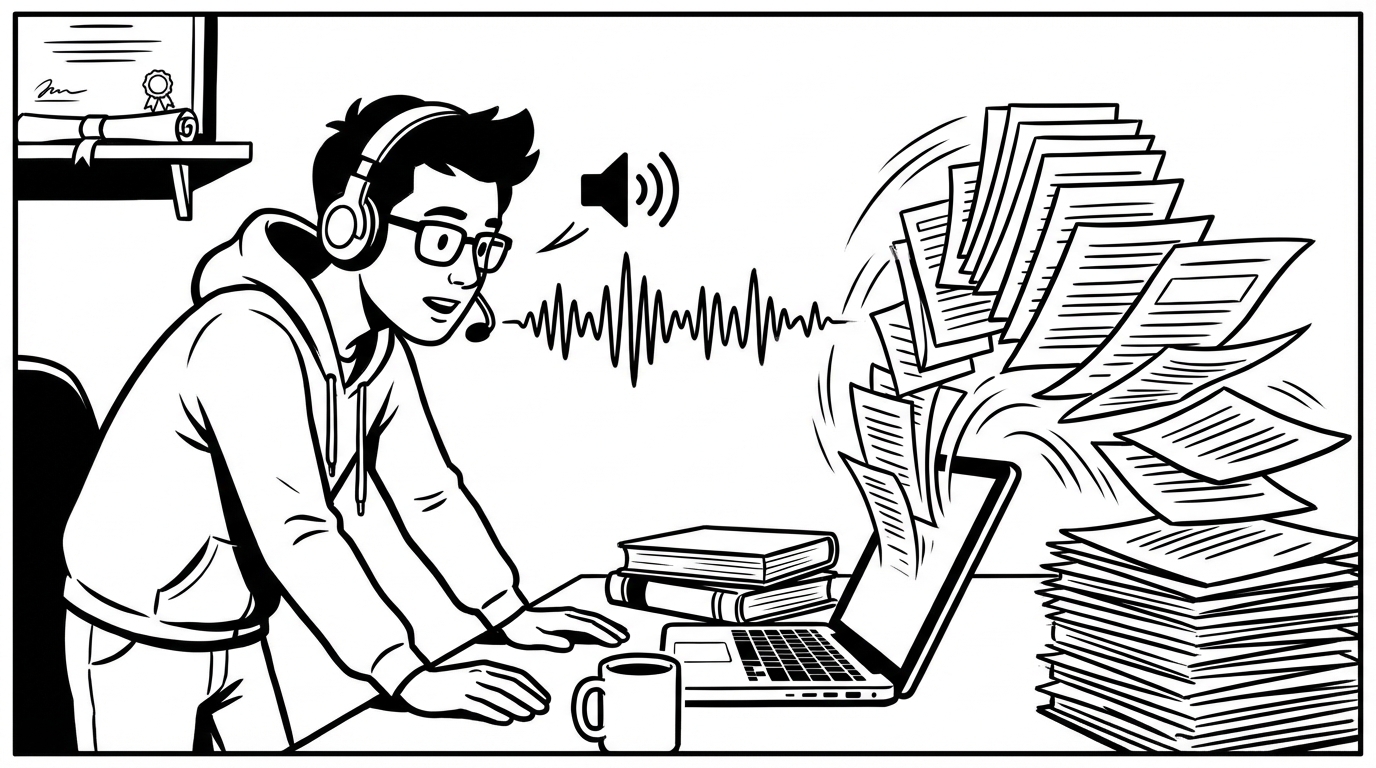
Writing a dissertation is one of the most sustained, high-volume writing projects most people will undertake. Tens of thousands of words, produced over years, requiring deep concentration, precise argumentation, and the ability to maintain momentum through the periods when momentum is hardest to find.
Voice dictation doesn't write the dissertation for you. But it meaningfully changes the pace at which you can produce draft material, which compounds over a multi-year project in ways that matter.
The Dissertation Writing Problem
PhD candidates face a particular version of the blank-page problem: not just not knowing how to start, but the immense psychological weight of the project making every sentence feel consequential. Typing a sentence, reading it back, deciding it's not good enough, deleting it — this loop runs on a longer and more anxious cycle when the output is a dissertation than when it's an email.
The other problem is sheer volume. A dissertation of 80,000 words produced entirely by careful, edited typing is an enormous physical undertaking, spread over years of writing sessions where motivation and energy vary enormously.
Voice dictation addresses both problems: it bypasses the typed-editing-loop that kills momentum, and it accelerates the pace of word production on days when you can get into the material.
Chapter First Drafts
The most important thing a dissertation writer can do is produce a complete draft — even a bad one — before revising. A draft you can revise is infinitely more valuable than a perfect outline that never becomes pages.
Voice dictation accelerates the draft production phase. The workflow:
- Have your outline, notes, and sources open
- Hold the hotkey and speak through the argument you want to make in this section
- Don't try to be good — try to be complete
- Paste the rough draft, move to the next section
The spoken first draft will be rougher than your eventual final text. It will also be longer — speaking tends to produce more words than typing before the editing refines them, which is useful in first drafts where the goal is coverage.
Literature Reviews
Literature reviews require synthesizing many sources into a coherent narrative of the field. This is a complex writing task that benefits from speaking for the same reason academic arguments do: you know the material, you've read the papers, you have a view about how they relate. Typing forces you to compose and structure simultaneously. Speaking lets you narrate the synthesis in one continuous flow and structure it in the edit.
"The field divides roughly into two camps on this question. The structural position, represented by Smith, Jones, and Chen, argues that institutional factors explain most of the variance. The agency position, associated with the Frankfurt School more broadly and with Adorno in particular, maintains that individual response to structure is where the interesting action is. What's missing from both accounts, and what I'll argue in this chapter, is..."
Speak the structure of the literature review as a narrative, paste it, reorganize and tighten. The intellectual work — knowing the literature and having a view on it — is already done. The speaking captures it.
The 500-Word Daily Habit
Many dissertation advisors recommend writing a minimum daily word count — 500 words is a common target — as a way of maintaining momentum across the long production timeline.
500 words by voice takes about four minutes of speaking. This isn't four minutes of polished argument — it's four minutes of rough first-draft prose on whatever section you're working on. But the rough draft is the point. You revise later.
The psychological impact of a four-minute minimum viable writing session is significant. On the days when motivation is low and the project feels overwhelming, the threshold of "four minutes of speaking" is lower than "a productive writing session." Meeting the daily minimum keeps the project alive. Voice dictation makes the minimum achievable on even the worst days.
Transcribing Research Conversations
After a meeting with your supervisor, a peer feedback session, or a conversation with a colleague that surfaced useful ideas — hold the hotkey and speak your notes immediately afterward.
Not a summary: your actual thoughts, the specific things that were said, the ideas you want to pursue, the objections you need to address.
"Supervisor meeting, February 15. She pushed back on my framing of the third chapter — the argument about institutional path dependency is too narrow, she thinks it forecloses some interesting cases. She suggested looking at the Mahoney 2000 piece which I haven't read. The methodological question about selection bias in the case studies is still unresolved — I need to add a paragraph explicitly justifying the cases and acknowledging the limitations. She liked the theoretical contribution framing in the introduction. Next meeting in three weeks."
That note, captured in 45 seconds while you're still in the building, is worth more than the typed summary you'd write two hours later from partial memory.
The Isolation Problem
PhD writing is isolated work, and isolation makes it harder. Voice dictation has an unexpected benefit here: speaking out loud, even to a microphone, slightly reduces the isolation of the blank-page session. You're articulating your argument out loud, hearing it as you speak it, engaging with the material as if explaining it to someone.
Some PhD candidates who use voice dictation describe their work sessions as feeling more like thinking-out-loud than like composition — a different relationship with the material that some find less isolating and more generative than silent typing.
It's a small thing. But over years of dissertation writing, small things that make the daily practice slightly more sustainable add up.
The Completion Argument
The dissertation that gets finished is better than the dissertation that doesn't. Every tool that makes completion more likely is worth using.
Voice dictation won't make your argument smarter or your evidence stronger. It will make it easier to produce the volume of prose that a dissertation requires, on more days, with less friction. That's a direct contribution to completion.
Your ideas are worth getting on the page. Speaking them there is faster than typing them.