Real Estate Agents: Write Listings and Follow-Up Messages by Voice
Property descriptions, showing follow-ups, offer summaries, client updates — real estate agents write constantly. Here's how voice dictation keeps up with the pace.
SERP Transcribe Team
Product
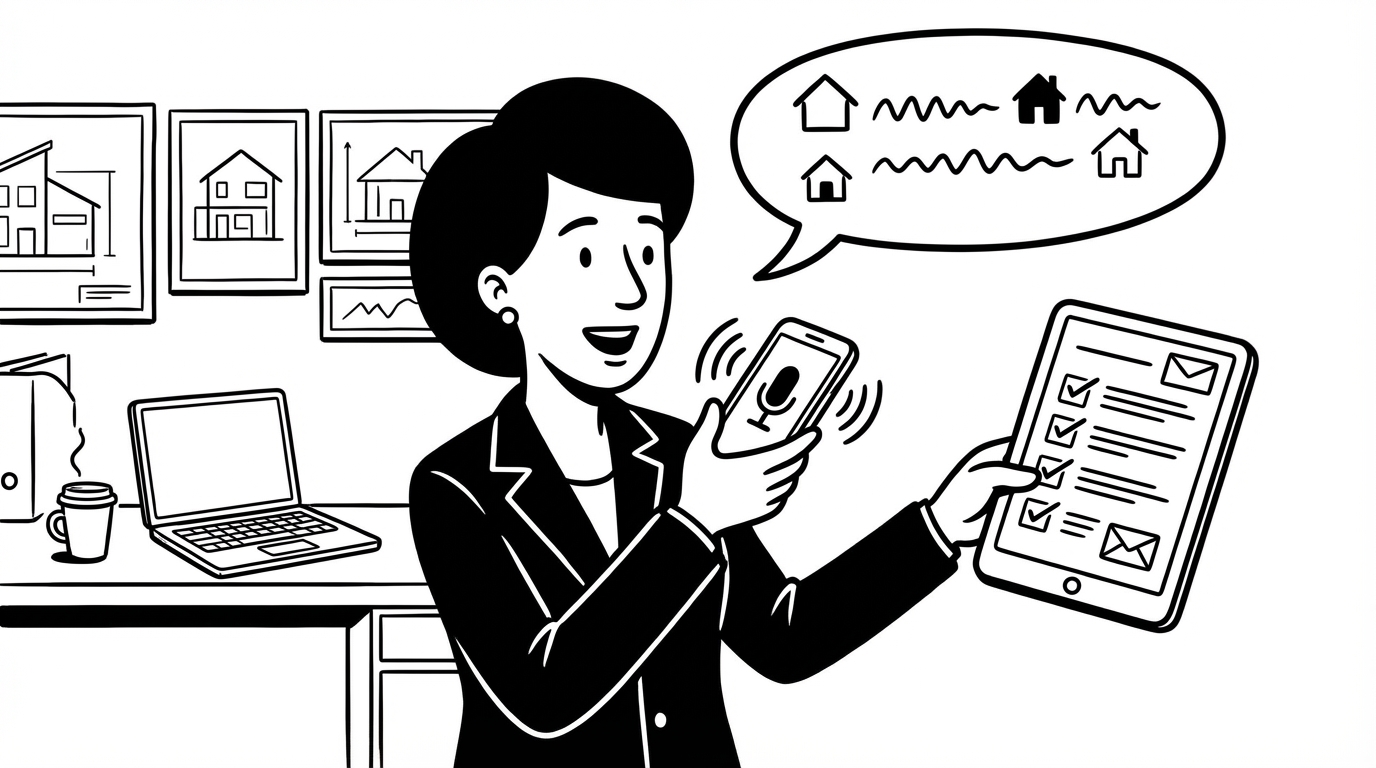
Real estate agents spend a surprising amount of their working day writing. Property descriptions, follow-up emails after showings, offer summaries for clients, market update messages, status emails to buyers and sellers — the communication side of the job never stops, and it all has to be done between showings, calls, and negotiations.
Voice dictation fits naturally into the pace of real estate work. Here's where it makes the biggest difference.
Property Descriptions
Writing a compelling property listing is one of the more genuinely skilled writing tasks in real estate. You're taking a set of facts — bedrooms, bathrooms, square footage, features — and turning them into something that makes a buyer feel something before they've walked through the door.
The problem is that most agents are writing listings after a full day of showings, on deadline, when their energy for prose composition is lowest. The result tends to be the same adjectives on every listing: "stunning," "beautiful," "move-in ready," "charming."
Voice dictation works here because describing a property out loud is more natural than composing a description in your head. You walked through the house. You saw the light in the kitchen. You noticed the garden. Speak about it the way you'd describe it to a friend who asked what the house was like:
"This one is special — it's a 1930s craftsman that still has all its original character. The living room has these incredible built-in bookshelves flanking a proper wood-burning fireplace and the light in the afternoon is amazing. The kitchen has been updated thoughtfully — they didn't tear out the original cabinetry, they kept it and painted it, and it works. The garden is bigger than you'd expect for the street, with a mature lemon tree and a covered patio that gets used. The main bedroom has an en-suite that was recently renovated. It's the kind of house that feels lived-in and loved."
That listing copy — specific, evocative, honest — came from 30 seconds of speaking about a house you just walked through. It would take most agents 20 minutes to type something comparable.
Post-Showing Follow-Ups
The email or message after a showing is one of the highest-leverage communications in the agent-client relationship. Sent quickly, while the showing is fresh, it keeps the client engaged and demonstrates attentiveness. Sent two days later, it feels like an afterthought.
Voice makes same-day follow-ups easy. Sitting in your car after a showing, hold your hotkey and speak:
"Hi David and Emma, great to show you 14 Elm Street this afternoon. My overall read: the bones are excellent and the location is as good as it gets on that street. The kitchen is going to need work — I'd budget $40–60k to do it properly. The garden sold me though, and you'd be the fifth owner. I'll send over the recent comps this evening so you can see where it sits relative to the ask. Let me know your thoughts — would love to hear what you're feeling."
Paste, send. That follow-up is sent within an hour of the showing. It's specific to the property, it gives them a concrete data point (the kitchen budget), and it asks for their reaction. That's what keeps a transaction moving.
Offer Summaries and Negotiation Updates
Buying or selling a property involves moments where clients are anxious and need clear, fast communication. When an offer comes in, when a counter is being considered, when something unexpected happens — the client needs to hear from their agent immediately and clearly.
Voice lets you send a substantive update fast:
"Hi Jennifer, wanted to update you as soon as I heard — we received an offer this afternoon. It's coming in at $885,000, which is $15,000 below asking. They've asked for a 45-day close and are requesting we leave the washer and dryer. Overall it's a reasonable first offer from a qualified buyer. I'll send the full paperwork over now. My read is that we counter at $910,000 with a 30-day close and keep the appliances off the table to start. Can we talk at 6pm to discuss?"
That message was spoken in 30 seconds. The client has the key facts, your interpretation, a suggested course of action, and a next step. Compare that to typing the same update while fielding calls and you understand why most update emails end up shorter and less useful than they should be.
Market Update Newsletters and Client Touchpoints
Many agents send regular market updates to their sphere of influence — monthly or quarterly emails that stay top-of-mind and demonstrate expertise. These typically don't get written as often as intended because they require dedicated writing time.
Voice makes them practical. Speak through the three or four things worth knowing about the local market right now, paste into your email template, do a quick edit pass, send. A market update that would take 45 minutes to write takes 10 minutes with voice.
Open House Notes
Walking through an open house and wanting to capture impressions for a buyer who couldn't attend? Voice is the natural tool. While you're there or immediately after, speak your observations:
"Okay just left the open house at 27 Pine — here's my read for you. The photos were flattering. In person the rooms are smaller than they appear and the street noise is more significant than I expected — it's on a corner. The renovation work is good quality though, the kitchen and bathrooms are well done. The storage is limited. I'd put it at the low end of its price range. Happy to talk through it if you want to see it anyway."
Speak it, paste it into a message to your client, send. They have a real perspective from someone they trust, delivered while it's relevant.
The Agent Who Keeps Up
Real estate moves fast, and the agents who keep clients most engaged are the ones who communicate most consistently. The challenge has always been that quality communication takes time, and time is the one thing agents don't have.
Voice dictation doesn't give you more time. It gives you more output from the time you already have. More follow-ups sent, more listings written with care, more clients updated on the day things happen.
In a relationship business, staying in communication is the whole game.