I Replaced Typing With Voice Dictation for 30 Days. Here's What Actually Happened.
A month of using voice dictation for everything — emails, messages, documents, notes. What worked, what was awkward, what I kept after the experiment ended.
SERP Transcribe Team
Product
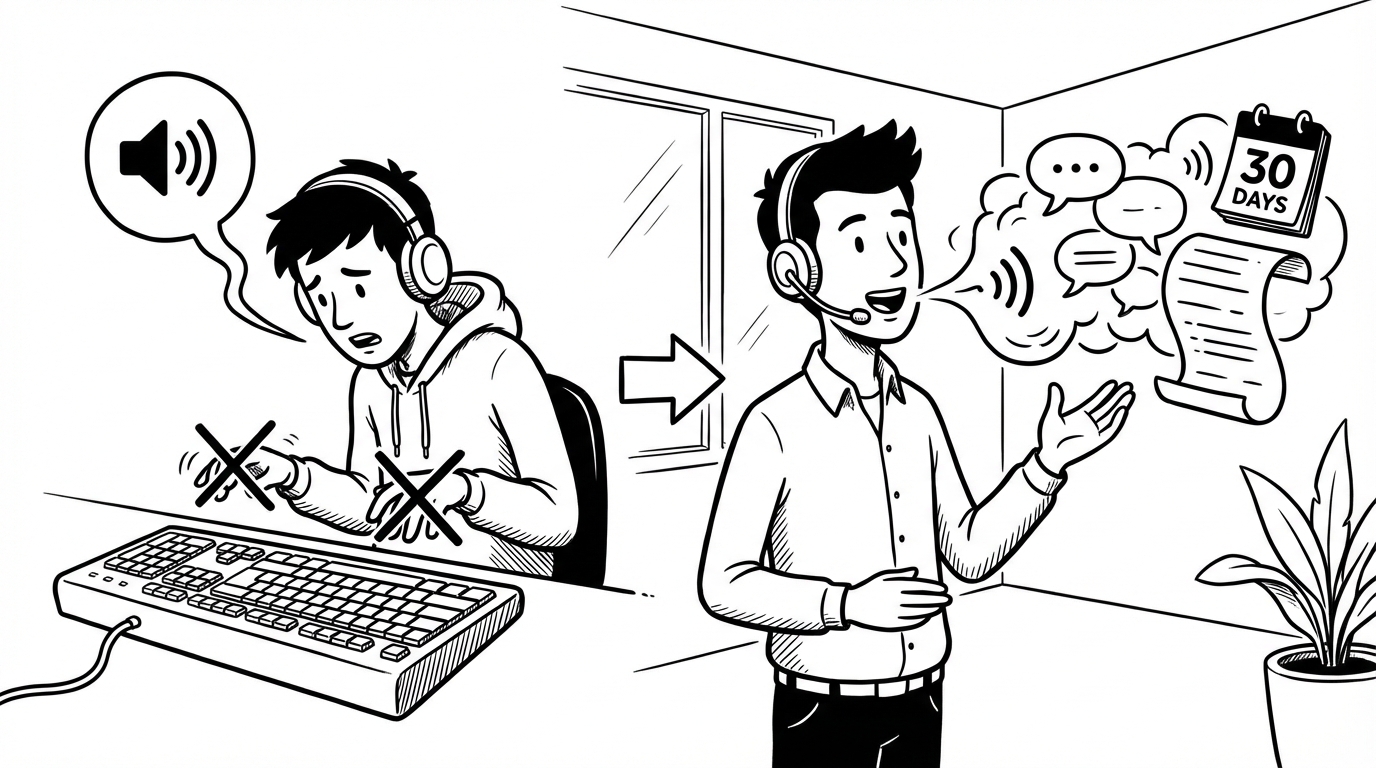
I've been a fast typist my whole life — about 90 words per minute on a good day. I never thought I needed to dictate anything. Typing felt natural, immediate, right.
Then I started noticing that I was spending a lot of my working day with my hands on a keyboard, and wondering whether that was actually the best way to get thoughts out of my head and into documents. So I ran an experiment: use voice dictation for everything I possibly could for 30 days. Emails, Slack, documents, journal entries, notes, social posts. All of it.
Here's what happened.
Week 1: Uncomfortable and Clunky
The first few days were genuinely awkward. Speaking to a computer felt strange. I kept trailing off mid-sentence, second-guessing words, speaking too fast or too slow. The output required more editing than I expected.
I also kept forgetting to use it. Muscle memory is real — my fingers would be on the keyboard composing something before I'd remembered I was supposed to be dictating.
By the end of week one, I was using it consistently but not naturally. I'd catch myself thinking "okay, voice dictation now" rather than just reaching for the hotkey reflexively.
Word count saved by dictation in week 1: Maybe 20% of my daily output. Less than I hoped.
Week 2: The Click
Something shifted around day 10. The hotkey stopped being something I remembered to use and started being something I just did. I'd think of what I wanted to say, hold the key, say it, paste.
The editing requirement dropped. I'd found a speaking pace that produced cleaner output — slightly slower than natural conversation, not robotic, just deliberate. The transcription started landing at 95%+ accuracy consistently.
Email was the biggest win. I'd dreaded long emails before this experiment — the blank compose window, the slow construction of each paragraph. Dictating them felt like calling someone instead of writing to them. The emails were better — warmer, more direct, less over-edited. And they took a third of the time.
Word count saved by dictation in week 2: Closer to 50%. The habit was forming.
Week 3: Finding What It's Good At
By week 3, I had a clearer sense of where dictation excelled and where it was the wrong tool.
Excellent for:
- Emails of any length
- Slack messages longer than one sentence
- Notes and brain dumps
- Document first drafts
- Morning journal entries
- Anything where getting thoughts out fast matters more than precision
Worse than typing for:
- Passwords and form fields
- Short, precise inputs (a date, a code, a URL)
- Anything requiring special characters
- Situations where I couldn't make noise
The hybrid workflow that emerged: speak the prose, type the specifics. Hold the hotkey for paragraphs and sentences, reach for the keyboard for URLs, numbers, and formatting.
Week 4: The New Normal
By the final week I'd stopped thinking of it as an experiment. It was just how I worked. The keyboard didn't go away — it's better for some things. But for producing language, voice had become my first instinct.
The most surprising finding: my writing improved. Not because dictation is a better writing tool, but because speaking forces you to commit to a thought before you express it. You can't write-and-delete endlessly when you're speaking. You say the thing, you hear how it sounds, you move on. The result is more direct, less tortured prose.
What I Kept After the 30 Days
I didn't stop typing. I dictate for:
- All emails longer than two sentences
- Any Slack message that needs context or nuance
- First drafts of documents and posts
- Notes and to-do capture throughout the day
- Anything I'd previously been procrastinating on because it "required writing"
I type for:
- Short, precise inputs
- Anything requiring special characters or code
- Situations where I can't speak (coffee shop, meeting)
- Single-word or single-sentence replies
The 30-day ratio: roughly 60% dictated, 40% typed. That feels sustainable and right.
Would I Recommend Trying It?
Yes, with realistic expectations. Week one will be uncomfortable. The habit takes about two weeks to feel natural. After that, most regular users don't go back — not because typing is bad, but because speaking is genuinely faster for producing language, and faster with less effort.
The tool I used was SERP Transcribe. The hotkey model — hold to record, release to paste — felt the most natural of the tools I tried. One key, one action, no mode switching.
If you type a lot, you should try this. Give it two weeks before you decide. The first week lies about how good it can be.