Teachers: Write Student Feedback and Parent Emails Faster by Voice
Teachers write more than almost any other profession — feedback, reports, parent communication, lesson notes. Voice dictation makes the paperwork part of teaching manageable.
SERP Transcribe Team
Product
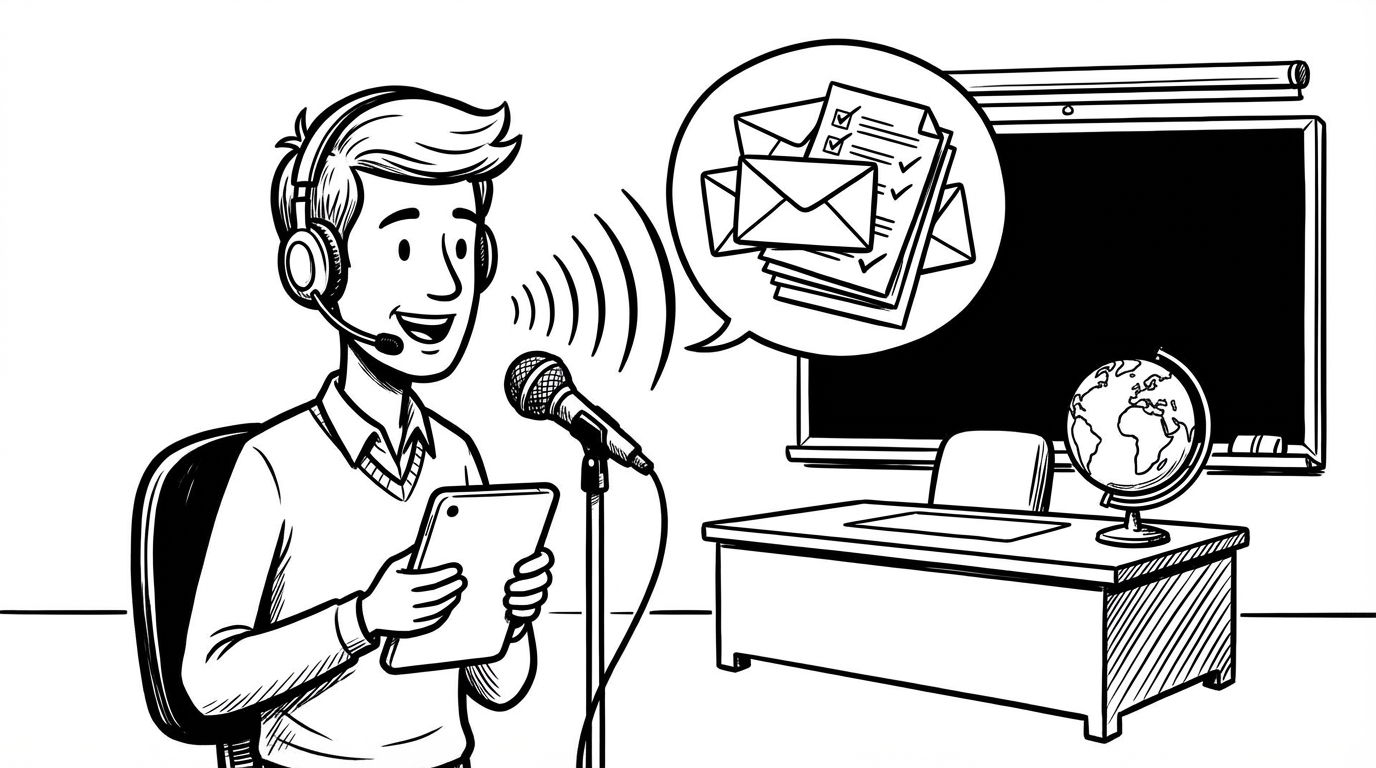
Teaching is one of the most writing-intensive professions there is, and most of that writing happens outside the classroom. Feedback on student work, progress reports, parent emails, lesson plans, meeting notes — all of it lands on evenings and weekends, all of it takes time, and very little of it is why anyone became a teacher.
Voice dictation won't eliminate the paperwork. But it will cut the time you spend on it significantly, which means more energy for the parts of teaching that actually matter.
Student Feedback
Written feedback on student work is one of the most time-consuming parts of a teacher's week. Meaningful feedback — specific to the student, focused on improvement, not just a grade — takes time to write for each piece of work.
The time cost is why so much feedback defaults to generic comments. "Good work," "needs improvement," "see me" — not because teachers don't have specific thoughts, but because writing those thoughts out for 30 students takes the better part of an evening.
Voice changes the time cost dramatically. For each piece of student work, hold your hotkey and speak the feedback you'd give if you were explaining it to the student in person:
"This essay has a strong central argument — you clearly understand the text. The main thing to work on is using evidence more precisely. In your second paragraph you make a claim about Gatsby's motivation but the quote you've chosen is from a different chapter and doesn't quite support it. Find the section where Gatsby first describes the green light and use that instead. The conclusion is good, especially the last two sentences."
That's specific, actionable, encouraging. It took 25 seconds to speak. Typed carefully, that feedback would take 3–4 minutes. Multiply by 30 students and you've saved nearly two hours of evening work.
Progress Reports and Written Assessments
Formal progress reports — the ones that go home to parents or into official records — are even more time-consuming because the standard is higher. Each one needs to be accurate, professional, and individualized.
Voice is useful here for the same reason: you know what you want to say about each student, you just need a fast way to say it.
For each student, speak through three things:
- What they're doing well
- What needs improvement
- What the goal is for the next period
"Marcus is making strong progress in reading comprehension this term — his ability to infer meaning from context has improved noticeably. He continues to find extended writing tasks challenging and benefits from structured scaffolding. Our goal for next term is to build confidence in independent writing by increasing the use of graphic organizers before drafting."
Speak it, paste it, do a quick edit for tone and formality. The report that usually takes 8 minutes per student takes 2.
Parent Emails
Parent communication is a particular writing challenge because the tone has to be carefully calibrated — professional but warm, honest but constructive, especially for sensitive messages about behaviour or performance.
Voice helps with tone precisely because speaking naturally produces a more human register than carefully composed typed email. You write to a parent the way you'd talk to them at a parent-teacher conference — direct, kind, clear.
For a positive update:
"Hi Mrs. Chen, I just wanted to share some good news — Jamie has been doing really well in class this week. She contributed to three discussions and submitted her first assignment fully completed and on time. It's been wonderful to see her engage more confidently. Just wanted to make sure you heard the positive things too."
For a concern:
"Hi Mr. Thomas, I wanted to reach out about Daniel's recent attendance — he's missed four morning sessions in the last two weeks, which is starting to affect his participation in the literacy unit. I don't want him to fall behind. Could we find a time to have a quick call this week to discuss?"
Both emails: warm, specific, professional, and to the point. Each took about 20 seconds to speak.
Lesson Planning and Notes
Lesson planning involves a lot of prose — instructions, learning objectives, differentiation notes, assessment criteria. Speaking through a lesson plan is often faster than typing it because you're describing what will happen rather than constructing a document.
End-of-lesson notes are especially valuable by voice. Right after a lesson, while your observations are fresh, speak a quick debrief: what worked, what didn't, who struggled, who excelled, what you'd change next time. Paste into your lesson plan or teacher notes. Those observations, captured in the moment, are worth far more than the post-hoc reconstruction you'd attempt a week later.
The Marking Mountain
For teachers who face a stack of marking, voice feedback is a way to give higher-quality responses to more pieces of work in the same time. Instead of choosing between speed (generic comments) and quality (specific but slow), voice gives you both.
Better feedback, produced faster, means students get more useful information about how to improve. That's the actual teaching outcome. Voice dictation is just the delivery mechanism.
Your evenings are worth protecting. Use voice to reclaim some of them.