UX Researchers: Capture Study Notes and Insights by Voice
Usability sessions, interview notes, synthesis documents — UX research involves constant writing. Voice dictation helps you capture richer observations without breaking your attention.
SERP Transcribe Team
Product
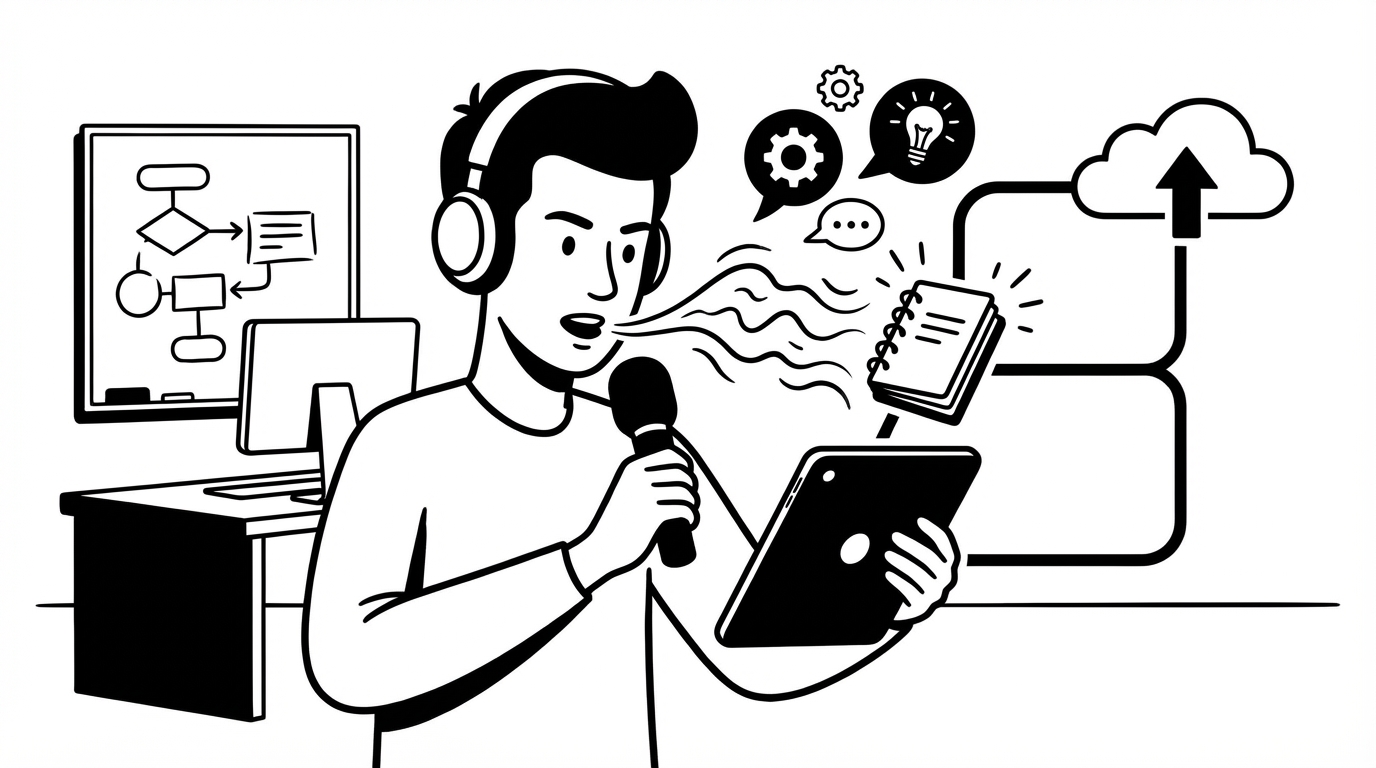
UX research has a documentation paradox: the moments that matter most — when a participant says something unexpected, when a pattern clicks, when you notice a behavior worth capturing — are exactly the moments when you're most focused on the participant and least able to stop and type a note.
Voice dictation resolves this. A whispered or low-volume voice note captures the observation without breaking your attention the way typing does.
During Usability Sessions
In moderated usability testing, the researcher's attention should be on the participant — their behavior, their reactions, their verbal and non-verbal responses. Typing notes during a session competes with that attention. Typing also creates audible keyboard noise that can subtly influence participants.
Voice dictation during sessions requires some setup and care:
- Use a second device (a phone or secondary laptop) with a directional mic pointed away from the participant
- Keep your voice very low — near-whisper — to avoid disrupting the session
- Speak brief observation tags rather than full sentences: "hesitated on the checkout button," "didn't notice the filter option," "asked about returns unprompted"
- Expand these tags into full notes immediately after the session while they're fresh
The goal during the session is to capture the observations that might otherwise be lost by the time you write up your notes. Brevity is fine — completeness can wait for the post-session expansion.
Post-Session Note Expansion
The most valuable use of voice dictation in UX research is the 10 minutes immediately after a session ends. This is when the richest observations are freshest — the quotes you remember, the behavioral patterns you noticed, the hypotheses that surfaced.
Hold your hotkey and speak a full debrief while the participant's session is still vivid:
"Session three with the 45-54 cohort. She navigated to the product page fine but completely missed the comparison feature — her eyes went straight to the price and she started clicking without reading the product details. When I asked about comparing options she said she didn't know that was possible. The language 'Compare products' in the nav isn't resonating — she was looking for something more explicit. Strong quote: 'I just want to know which one to get, I don't want to figure it out myself.' That's worth including verbatim. She also mentioned she only shops on her phone, which is relevant for the responsive design issues we saw earlier."
That note — specific, rich, includes a direct quote, flags the design implication — took 40 seconds to speak. Typed after a full day of sessions from memory, it would be half as detailed and probably missing the quote.
Research Synthesis
Synthesis — moving from individual observations to patterns and insights — involves a lot of writing. Affinity diagrams get turned into documents, themes get articulated, recommendations get written. Voice dictation is well-suited to this phase because synthesis is fundamentally verbal reasoning that you're then committing to text.
Speak your thinking as you work through it: "The pattern I'm seeing across sessions two, three, and five is that participants from the 45+ cohort are treating this as a mobile-first experience but the mobile experience has the most friction. That's the insight — not that they're confused by the interface, but that we've designed for desktop and the primary user is on mobile."
Spoken synthesis captures the reasoning chain, not just the conclusion. When you need to write the insights document, the reasoning is already on the page.
Interview Note-Taking
For user interviews (as distinct from usability sessions), voice capture during and after is easier — you're not watching someone perform a task, you're having a conversation.
During the interview: use your hotkey to capture direct quotes and notable responses as they happen, in pauses or natural breaks. "Quote: 'I've never thought about where my data goes, I just assume it's fine' — worth flagging."
After the interview: full debrief by voice covering the main themes, the most interesting responses, the things that surprised you, and how it connects to or diverges from previous interviews.
Writing Research Reports and Decks
The final deliverable of UX research — the report, the presentation, the recommendations document — involves significant writing work that voice handles well.
Speak section by section. The methodology section, the key findings, the recommendations — each one is a sustained explanation that flows better spoken than typed. The editing pass shapes the spoken draft into professional document format, but the ideas, the reasoning, and the specific wording of insights often land better from speaking than from composing.
The Attention Dividend
The most valuable thing voice dictation gives UX researchers isn't speed — it's undivided attention during the sessions that matter most. When you're not trying to type notes, you're fully present with the participant. You catch things you'd miss while typing. Your follow-up questions are better because you heard the full response. The research is better because you were actually watching.
The documentation catches up. The attention can't be recovered after the fact.