Voice Dictation Is a Thinking Tool, Not Just a Typing Replacement
The speed benefit of dictation gets all the attention. But the more interesting advantage is what speaking does to the quality of your thinking.
SERP Transcribe Team
Product
The pitch for voice dictation usually focuses on speed. You speak at 120–150 words per minute. You type at 50–70. The math is simple: dictating is faster, therefore you save time.
This is true and worth having. But it understates what actually changes when you switch from typing to speaking as your primary mode of producing language. The speed benefit is the surface change. The thinking benefit is the deeper one.
The Typing-Editing Loop
When you compose by typing, you typically edit as you go. You type a sentence, read it back, decide it's not quite right, delete part of it, retype. This loop — compose, evaluate, revise, continue — is so automatic that most writers don't notice they're doing it.
The loop has a cost. It interrupts the flow of thought with the flow of evaluation. The part of your mind that's judging the sentence quality is competing with the part that's generating the next idea. Often the generator loses — the evaluator stops you mid-sentence to revise, and the next idea that was forming gets dropped.
This is why experienced writers talk about the importance of "turning off the inner critic" during first drafts. The critic interrupts the generator. Getting the critic to stand down, even briefly, is genuinely hard when the interface (typing) invites constant micro-evaluation.
Speaking Changes the Dynamic
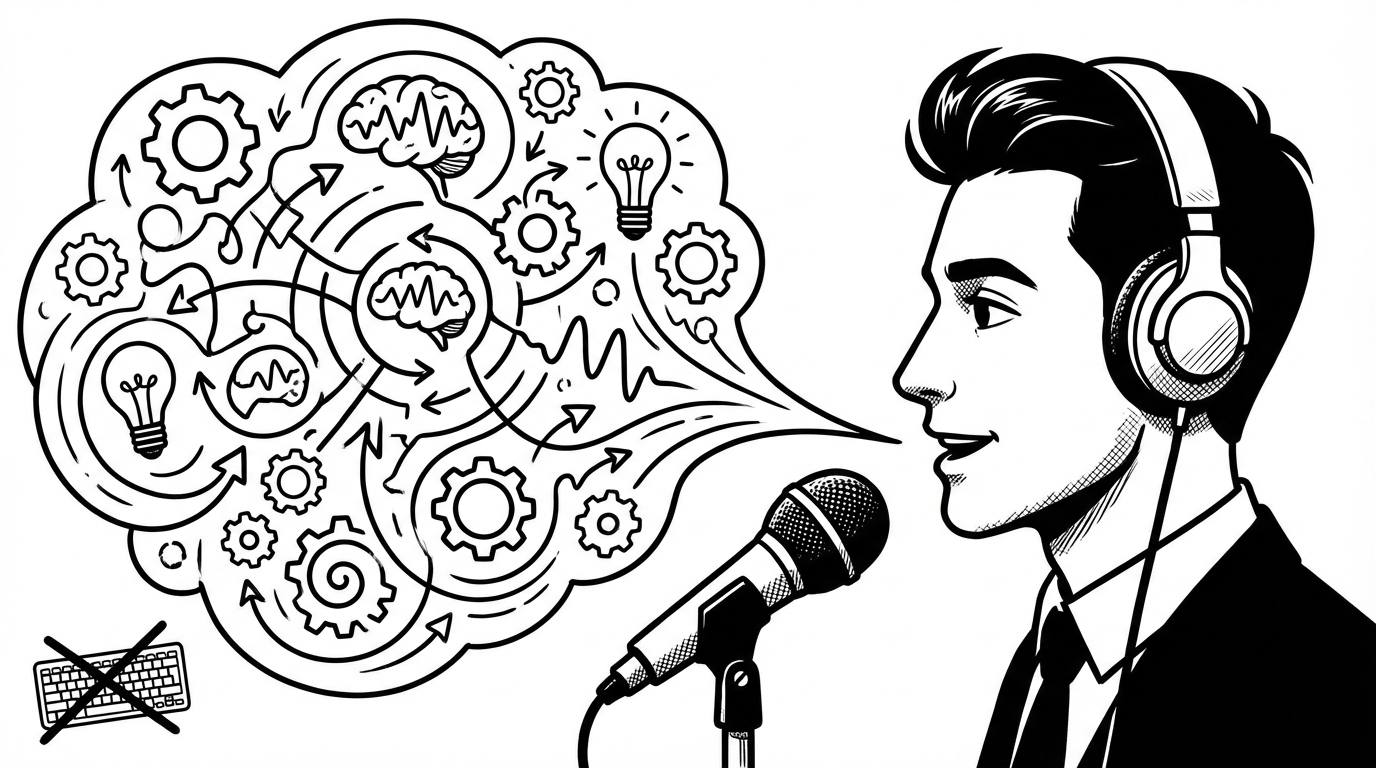
Speaking doesn't invite the same level of real-time evaluation. When you speak, you commit to the thought before it's complete — you open your mouth and words come out, and you hear them after the fact rather than before you commit to them.
This sounds like a disadvantage (you can't edit in real time), but for idea generation and first-draft thinking, it's actually an advantage. The evaluator operates on a delay. The generator gets more uninterrupted time. Ideas that would have been interrupted and discarded mid-formation get to reach completion.
You've probably experienced this in conversation — an idea comes out more clearly and completely than you expected, or you discover what you think about something in the act of explaining it. "I didn't know I believed that until I said it" is a real phenomenon. It's the generator running without the evaluator.
Voice dictation can reproduce this phenomenon in your solo work. When the output you're producing is spoken rather than typed, the thinking that produces it often runs more freely.
The Practical Difference
People who switch to voice dictation for first drafts often report that the output is better — not just faster. More direct. Less over-edited. More confident in the argument. More alive.
This isn't a coincidence. It's what happens when the generator gets less competition from the evaluator.
The edit pass — which still needs to happen — catches the places where the generator ran too freely. An argument that came out slightly backwards gets restructured. A sentence that was clear when spoken turns out to be ambiguous in writing and gets reworded. This is the evaluator doing its proper job: on finished material, not on in-progress thought.
The key shift is sequencing. Generate first, completely, without interruption. Evaluate second, on the full output. Typing makes this discipline difficult because the interface invites editing. Speaking makes it natural.
Talking Through Stuck Problems
Voice isn't only useful when you know what you want to say. It's particularly powerful when you don't — when you're stuck, unclear, or need to work out what you actually think about something.
Hold the hotkey and start talking: "I'm trying to figure out the structure of this argument and I'm not sure it's working. The first part establishes the problem. Then I go to the historical context. Then I bring in the counter-argument, which is where I lose it — I'm not sure the counter-argument is strong enough to warrant that much space. Maybe the counter-argument should come earlier..."
That's thinking out loud. It's the kind of thinking that happens naturally when you explain a problem to a colleague or think through something on a walk. Voice dictation captures it — the thinking happens and leaves a trace.
The captured trace is usually more useful than you expect. When you read back your spoken thinking, you often find the structure of the solution already there, partially formed, ready to be shaped into the final argument.
Rubber Duck Debugging, But for Writing
Programmers have a practice called rubber duck debugging: when stuck on a bug, you explain the code out loud to an inanimate object (a rubber duck). The act of explaining forces you to articulate what you expect versus what's happening, which frequently surfaces the problem.
The same mechanism works for writing. When you're stuck on a document, speaking it out loud — even to no one, even just to the room — forces the kind of articulation that reveals where the thinking is broken. "I'm trying to say that X, but that requires Y to be true, and I'm not sure Y is true" is a realization that might take an hour of staring at a typed draft and five minutes of speaking.
The Tool as Thinking Partner
Voice dictation, used this way, isn't a replacement for typing. It's a different interface that's better suited for the generative, exploratory phase of thinking and writing — and roughly equivalent for the refinement phase.
The implications for how you use it: consider switching to voice not just when you have something clear to say, but especially when you're stuck, unclear, or trying to figure out what you think. The speaking might surface the answer that the staring-at-the-screen wasn't producing.
The speed benefit is real. The thinking benefit might be worth more.