Voice Dictation Changes How You Think, Not Just How Fast You Type
The speed benefit of voice dictation is obvious. The cognitive benefit — what happens to your thinking when you remove the friction between thought and text — is more surprising.
SERP Transcribe Team
Product
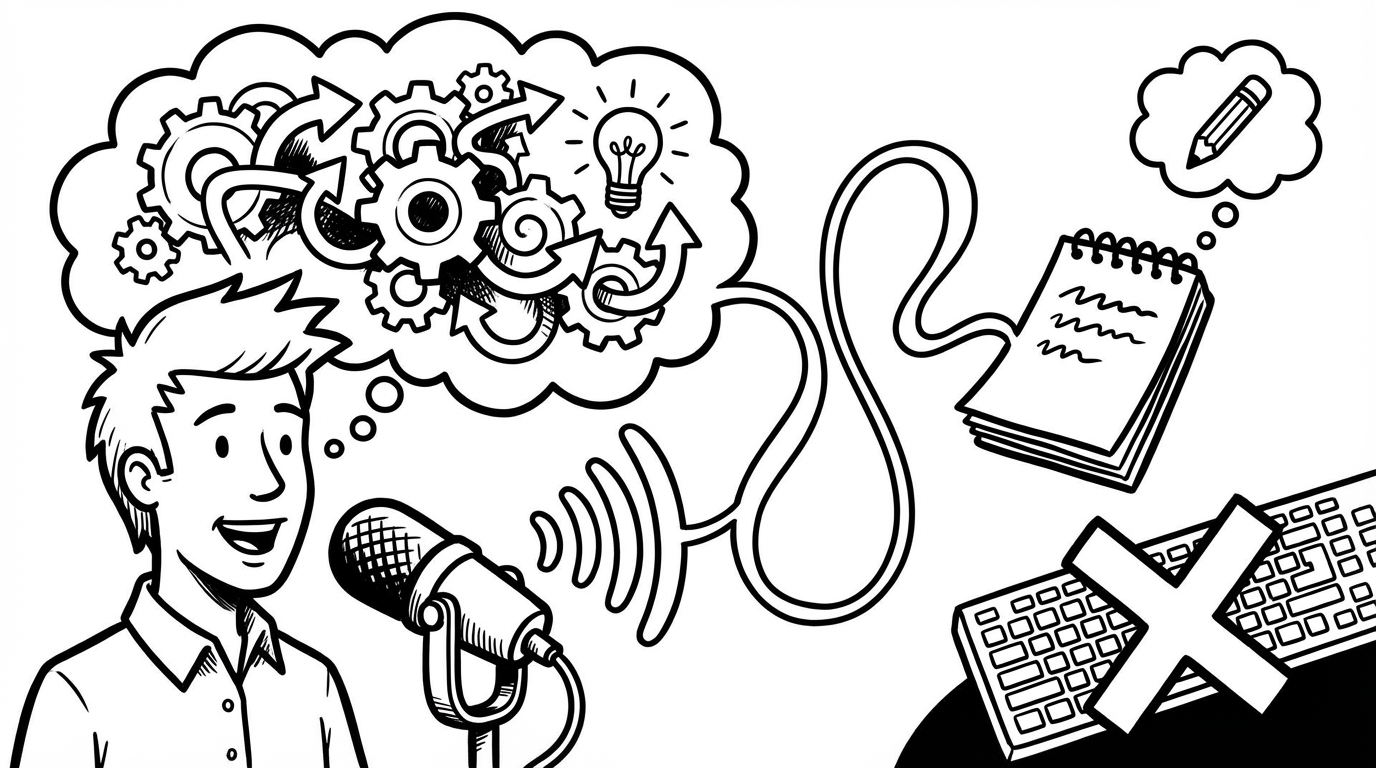
People try voice dictation for the speed. They keep using it for something harder to articulate — something that happens to their thinking when the friction between having a thought and getting it out of their head is reduced to almost nothing.
This isn't mystical. There's a straightforward cognitive explanation. And once you understand it, the productivity case for voice dictation becomes bigger than the words-per-minute math suggests.
The Bottleneck Nobody Talks About
The typical framing of voice dictation's benefit is: speaking is faster than typing, therefore you can produce text faster. This is true and useful. But it misses the more significant effect.
When typing is the output mechanism, your thinking adapts to the speed of your fingers. You produce one sentence, type it, and by the time it's on screen, the next thought has been queued and partially formed. The ideas that come faster than you can type get lost. The tangents you'd follow if you could keep up get abandoned. Your thinking narrows to fit your output speed.
When speaking is the output mechanism, your thinking doesn't need to slow down for your fingers. You can follow a train of thought at the speed it actually moves. One sentence produces the next produces the next, and the whole chain of reasoning can land on the page before any part of it gets away.
This is why the first time many people dictate something they've been struggling to write, it comes out better than anything they'd typed — not because they're performing differently, but because their thinking is less constrained.
Writing as Thinking
For most knowledge workers, writing isn't just communicating what they think. Writing is how they figure out what they think. The process of articulating an idea in words clarifies the idea — or reveals that it wasn't as clear as it felt.
Voice dictation accelerates this process. When you speak a draft rather than type it, you produce a rough version of your thinking faster, which means you get to the refinement stage — where the real thinking work happens — sooner.
The writer who speaks a 500-word first draft in five minutes and then spends twenty minutes shaping it has done more thinking in 25 minutes than the writer who spends 25 minutes carefully composing the same 500 words. The speaker got to engage with the whole argument earlier. The typer was still constructing the first third.
The Capture Effect on Ambient Thinking
There's a second cognitive change that comes with voice dictation: you start using the thinking time that was previously lost.
Commuting, exercising, cooking, walking — these are thinking times. Your brain is active. Ideas form. Connections happen. With no good capture mechanism, most of that thinking evaporates before you can use it.
Voice dictation makes these ambient thinking sessions productive in a way nothing else does. You notice a thought worth keeping, hold a hotkey, and speak it. Two seconds, and it's captured. Over weeks and months, the accumulated captures are a significant addition to your thinking output — ideas that would have been lost, now preserved and usable.
Heavy users of voice dictation often describe a feeling of their thinking becoming more productive without becoming more effortful. What changed wasn't how hard they thought. It was how much of what they thought they kept.
Reducing the Fear of the Blank Page
Writer's block — the inability to start writing despite having something to say — is largely a product of the gap between thinking and typing. You have a vague sense of what you want to say but not the precise words, and the blank page demands precisely formatted words before you can begin.
Speaking doesn't demand precision in the same way. You can say approximately the right thing, the transcript captures something approximating your intention, and you edit from there. The friction of starting is lower because you're not committing to words the way you commit to typed text — you're just talking.
Once you have something on the page, even a rough spoken draft, the thinking work of refining it can begin. The block was never about not having thoughts. It was about the gap between having thoughts and getting them into a form you could work with.
The Compounding Effect Over Time
The cognitive benefits of voice dictation compound. As you build the habit of speaking drafts, you become better at thinking out loud. Your spoken first drafts get cleaner. Your capture habit develops until the thoughts that occur to you in the margins of your day reliably land somewhere useful.
The person who has dictated daily for six months has a different relationship with their own thinking than the person who types everything. Not because they became smarter. Because they stopped losing as much.
That's the real case for voice dictation. The speed is the obvious part. The thinking is the part worth staying for.