Voice to First Draft: A Workflow for Nonfiction Writers
A step-by-step voice dictation workflow for nonfiction writers — how to go from research and notes to a complete first draft by speaking, not typing.
SERP Transcribe Team
Product
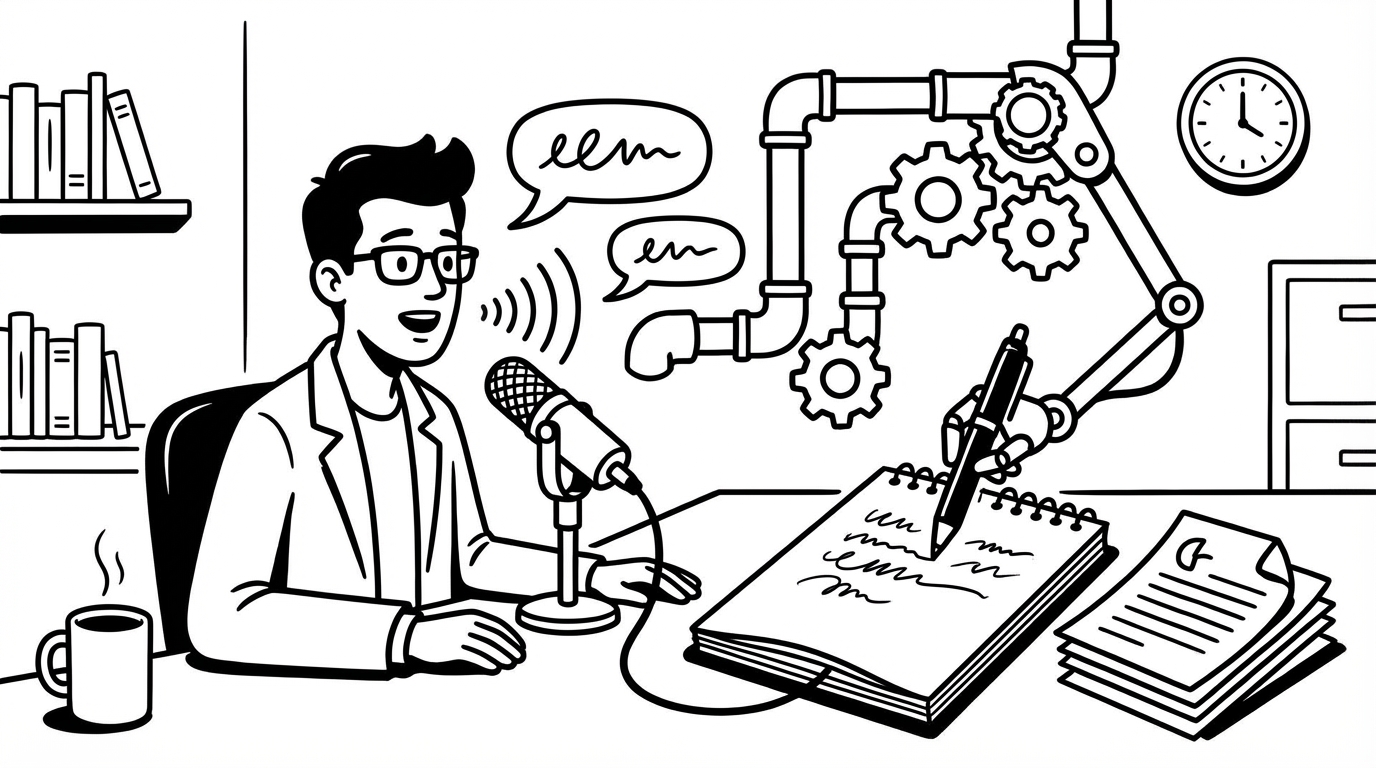
Nonfiction writers have a specific advantage when it comes to voice dictation: they know their subject. They've done the research, they understand the argument, they know the story they want to tell. The bottleneck isn't knowledge — it's translating that knowledge into prose.
Speaking is a faster and more natural way to make that translation. This guide is a complete workflow for nonfiction writers who want to make dictation a core part of how they produce first drafts.
Why Nonfiction Lends Itself to Dictation
When you know a subject well, you can explain it. That's the basis of all good nonfiction writing — taking what you know and making it clear and useful for someone who doesn't know it yet.
Explanation is a speaking mode. You don't compose explanations — you give them. A good nonfiction chapter reads the way a smart person would explain the topic to a thoughtful friend. Getting to that register by typing often requires multiple passes. Getting there by speaking happens in the first draft.
The nonfiction writer who speaks their draft often finds it clearer, less overwritten, and more direct than the version they would have typed. The editing pass is about tightening and structuring, not discovering the voice — it's already there.
Phase 1: Research Notes as Dictation Prompts
Before dictating a section, review your research notes for that section. Don't try to hold it all in your head — have your notes open where you can glance at them while speaking.
Your notes serve as dictation prompts: facts to include, quotes to reference, examples to work through. You're not reading from them — you're using them as scaffolding for an explanation you give in your own words.
What to type before the dictation session:
- Key facts, statistics, and quotes with their sources (always type these for accuracy)
- The argument or takeaway for this section in one sentence
- Two or three examples or stories you want to include
What to dictate:
- The explanation connecting all of the above
- Your analysis and interpretation
- The transitions between points
- Your authorial voice and perspective
Phase 2: Section-by-Section Dictation
Work through your chapter or article section by section. For each section:
- Read your notes for that section (30 seconds)
- Hold your SERP Transcribe hotkey
- Speak the section as an explanation — as if you're teaching this material to a smart person who doesn't know it yet
- Release, paste
- Repeat for the next section
Don't stop to evaluate what you've written until the whole section is done. Forward momentum is the point.
A useful mindset: You're not writing a chapter. You're giving a lecture to one person. The camera is off, the notes are in front of you, and you're just explaining what you know.
Phase 3: Working In Research Precisely
For facts, statistics, and direct quotes from your research — stop and type these. Don't dictate them. Numbers get transposed, names get garbled, and quotes need to be exact.
The workflow for a research-heavy paragraph:
- Dictate the surrounding context and explanation
- Type the specific fact or figure into the pasted text
- Continue dictating
This hybrid approach — dictate the analysis, type the data — produces accurate, naturally-voiced prose faster than either pure dictation or pure typing.
Phase 4: The Structure Pass
After dictating a complete first draft, do a structure pass before the prose editing pass. Read through and ask:
- Does each section have a clear point?
- Is the argument building logically?
- Are there missing connections between ideas?
- Does the opening set up what the chapter delivers?
- Does the close land the key takeaway?
Fix structural issues first. Adding transitions, rearranging paragraphs, strengthening the through-line — these are keyboard tasks but they come before line editing.
Phase 5: Prose Editing
After structure is solid, do a prose edit pass. This is where you tighten dictated language:
- Remove repetition (spoken language repeats more than written language should)
- Sharpen metaphors and examples
- Fix sentence-level rhythms that don't flow when read
- Integrate research references cleanly
By this stage, you're refining a complete draft rather than creating text from nothing. The heavy lifting is done.
Practical Tips for Nonfiction Dictation
Speak arguments, not sentences. Rather than trying to speak a perfect sentence, speak the complete argument: "The reason this policy failed is that it addressed the symptom rather than the cause. It reduced the visible measure of the problem without changing the underlying incentive structure that produced the problem in the first place. Three years later, the numbers were back where they started."
Use your own examples first. Original examples — your own observations, experiences, or case studies — are easiest to dictate because you're drawing on firsthand knowledge. Research examples require more precision (names, dates, figures) so handle them in the hybrid mode.
Dictate your transitions. Transitions are often neglected in first drafts. Dictating them — "The question this raises is..." or "That brings us to the second point..." — keeps the reader with you through the argument and is easy to do by voice.
Record yourself if you get stuck. If a section is genuinely hard to write, try explaining it verbally without the hotkey first — just talk through it out loud. Once you've found your way through the explanation, then hold the hotkey and repeat it. The spoken trial run often breaks the block.
Output Expectations
A practiced nonfiction writer can dictate 1,500–2,500 words of first draft per hour in a solid session. That's a complete chapter of a typical nonfiction book (5,000–8,000 words) in three to four hours of dictation time, plus perhaps two to three hours of editing across the phases described above.
Compare that to the writer who types the same chapter over two or three days. The nonfiction book that felt like a three-year project starts to look like a twelve-month project with dictation as a core tool.
The words per hour aren't the whole story — the quality has to be there too. But for nonfiction writers who know their material, the dictated first draft quality is usually high enough that the editing pass is a refinement, not a rewrite.