Voice Typing While Cooking, Walking, or Doing Chores
Your hands are busy but your brain isn't. Here's how to capture ideas, reply to messages, and check off to-dos during the parts of your day when typing isn't possible.
SERP Transcribe Team
Product
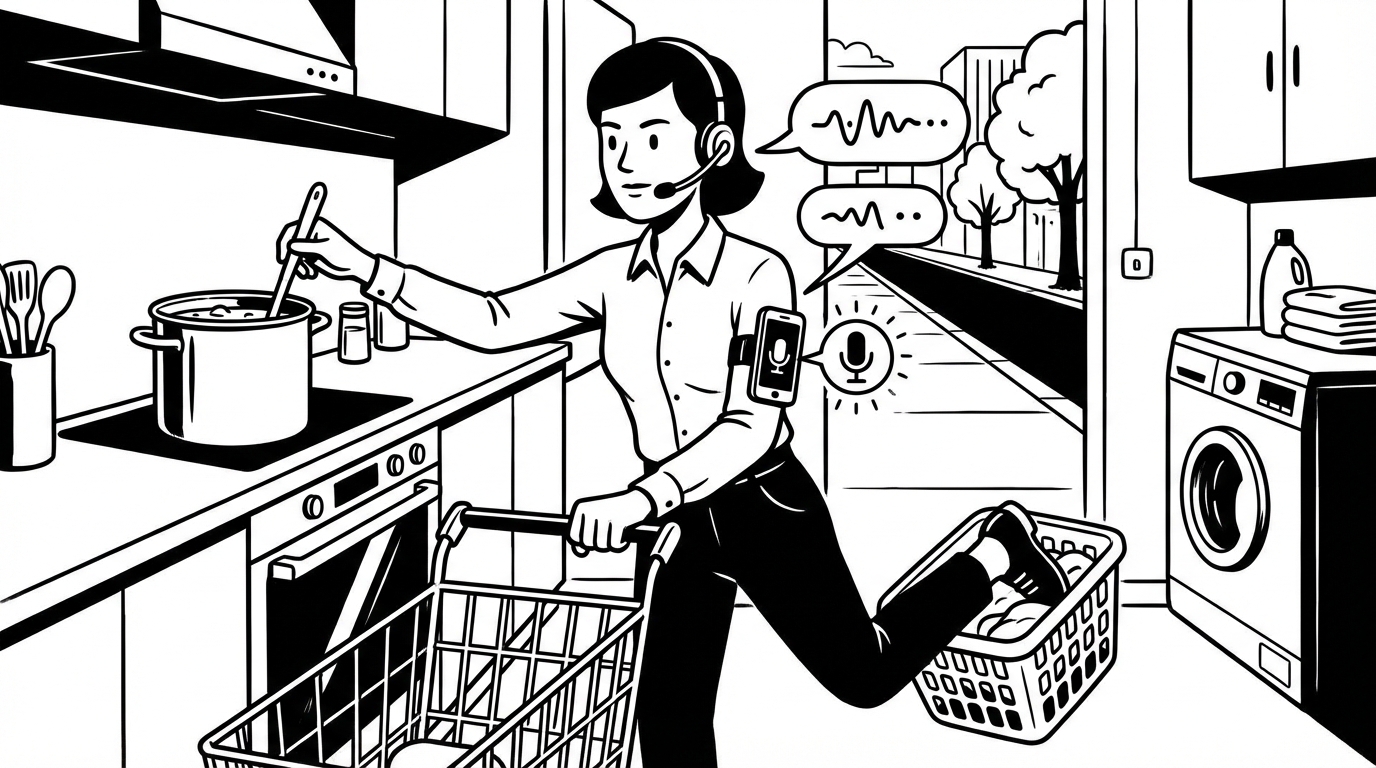
Some of the best thinking happens when your hands are occupied. Cooking, folding laundry, doing dishes, going for a walk — these are the moments when ideas surface, things you need to remember pop into your head, and your brain works through problems you've been stuck on.
They're also, historically, the moments when you can't do anything about it.
Voice dictation changes that. Here's how to make the "hands-busy" parts of your day actually productive.
The Hands-Busy Problem
When you're cooking or doing chores, you have a few options when a thought occurs to you:
- Try to remember it until you're done (usually fails)
- Stop what you're doing to type it (annoying and messy)
- Speak it and let it be captured
Option three is clearly best, but it requires a setup that makes speaking quick and easy. SERP Transcribe at your desktop or laptop nearby makes this work if you can get to a keyboard for a second to trigger the hotkey. For fully hands-free capture, your phone's built-in mic dictation (or a smart speaker) works too.
The key is having a system — some capture method that works when your hands aren't free — so thoughts don't evaporate.
What's Worth Capturing in These Moments
Ideas that surface. The shower-thought phenomenon is real — when your brain isn't focused on a task, it makes unexpected connections. If you're doing dishes and suddenly understand how to fix the problem you've been stuck on at work, that insight is worth five seconds of effort to capture.
Things you need to remember. "Need to text back Sarah," "pick up milk," "reschedule the dentist" — these surface constantly during autopilot tasks. Speak them the moment they arise.
Content ideas. If you write, post on social media, or create anything, your best ideas often come when you're not trying to have them. Cooking dinner is a surprisingly fertile idea-generation environment.
Messages you want to send. Sometimes you compose an entire text or email in your head while you're doing something else. Capture it while it's formed rather than trying to reconstruct it later.
Setting Up for Hands-Free Capture
Laptop on the counter while cooking: A simple setup that works well. Your laptop is open on the kitchen counter playing music or a podcast. When a thought occurs to you, you have a keyboard nearby. Wipe your hands, hit the hotkey, speak, paste into your notes app or wherever it belongs. 20 seconds.
Phone mic dictation: On iPhone, holding the microphone button on the keyboard or asking Siri to "add this to my notes" works without SERP Transcribe. The same habit, different tool. The output goes to Notes or Reminders immediately.
Smart speaker for one-shot notes: "Hey Siri, remind me to call the plumber tomorrow" or "Hey Google, add olive oil to my shopping list" — these are voice capture tools that work completely hands-free and are underutilized by most people who own them.
The point isn't which tool you use. It's building the habit of speaking thoughts rather than trying to hold them.
The Walking Workflow
Walks — especially solo walks — are prime idea time. A lot of people have started recording voice memos on their phones while walking. This is a great habit, but voice memos require going back and listening to transcribe them.
If you use your phone's built-in speech-to-text (microphone on the keyboard, Siri Notes, or any voice-memo-to-text app), the transcription happens in real time. A 20-minute walk can produce a page of notes, ideas, or drafted messages that are ready to use when you get back.
The best walkers-who-also-think have learned that walks are working time. You just need a capture method that doesn't require stopping.
Don't Over-Engineer It
The temptation is to set up an elaborate hands-free system with the perfect app and workflow. Resist this. The barrier to capture should be as low as possible — ideally one tap or one key press.
Whatever you already have that gets you to a microphone in under three seconds is good enough. The goal is the habit of speaking thoughts the moment they arise, not the perfection of the tool.
Your hands are going to be busy anyway. Your brain might as well be doing useful work.